Episode Transcript
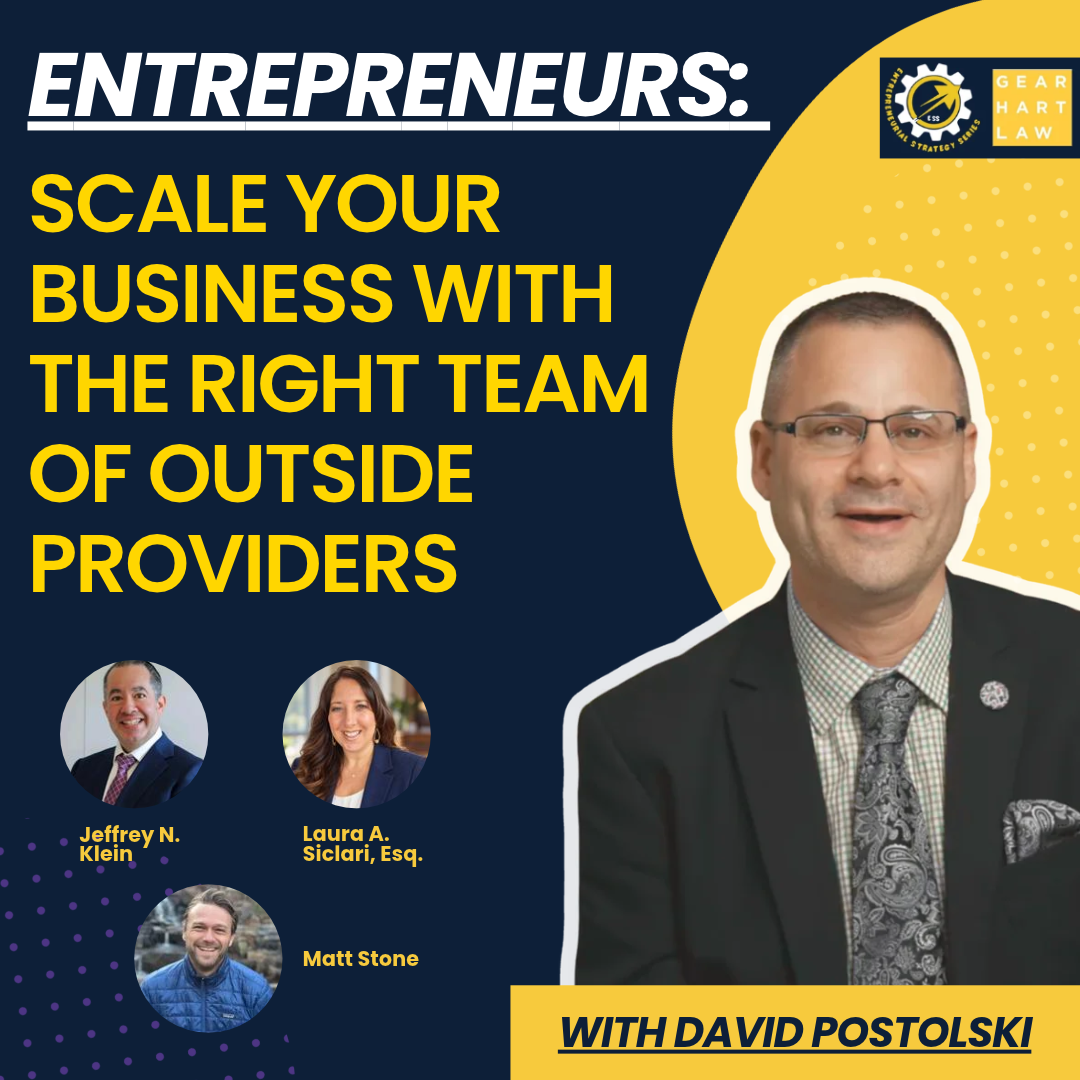
[00:00:00] David Postolski, Esq.: Hello everyone, my name is David Pustolski. I am super excited about this particular session because most of my clients are startups, entrepreneurs and emerging companies and they usually come to a point, I think someone put it best, I think it was Julia who said it. They get to that messy part where they're like, they're like, they're, they're like doing well, have to, have to, have to, have to expand, have to work with strategic partnerships, looking for investment, looking to grow their, their team and they just kind of don't know where to go first. And, and so usually people will come to us as their IP attorneys to ask who are some kind of recommended partners that, that we trust and could refer to. And these are the people that you're going to be hearing from today. Jeff Klein, Please my friend, introduce yourself.
[00:00:58] Jeffrey N. Klein: Thanks very much David. Great to be here and really, really excited to see such a wide range of backgrounds and experiences here in the group. So great to be here and look forward to having a really exciting conversation over the next hour or so. I'm Jeff Klein, I'm a partner at Life Science Legal. We're a boutique law firm and we work primarily with small and medium sized life science companies. So that includes pharma companies, biotech, medical device companies, many of whom are at exactly the stage that we're talking about today. So companies that are transitioning from the, from the startup stage to the, to the scale up stage and beyond.
Primarily our work covers a lot of the agreements and critical transactions that run and grow a Life science company.
Also a lot of the regulatory and compliance issues that come with, with operating in our industry, which is an incredibly highly regulated industry. And so beyond the individual deals that I work on, I sit on advisory boards, boards of directors, work directly with senior management on issues that are, that are critical to companies and decisions that really are shaping where the company is, is, is going over the next days, weeks, months and beyond. So regarding our topic today, I kind of come with that topic from two different angles.
First, obviously as a law firm, as an, as an outside law firm, I'm one of the outside providers. But more than that, a lot of my day is spent working with other outsourced providers and setting up a company's relationships with those outside providers who are, who are critical to a company's growth and development.
And this includes things like CROs, which run clinical trials and pre clinical research, CDMOs which are the manufacturers that make the product, regulatory manufacturing consultants and a whole host of other things. Even including as a company gets closer to market things like specialty pharmacies, distributors, patient support programs, and increasingly that list of outsourced providers is also including data and artificial intelligence vendors that are touching various aspects of everything these days.
So what that really means and sort of how that impacts kind of my day to day and the day to day in a lot of the companies that I deal with is you could have a 10 person biotech company that's running a clinical trial across dozens of sites in multiple countries, product that's made in a different part of the world and almost none of the people that work there are our employees. And so getting those relationships right is really a big part of what scaling means. So anyway, I don't want to go on too long, but it's a very exciting topic. I'm looking forward to having a great conversation with everyone here and hearing from the other panelists and hopefully everyone's going to walk away today with a few practical things that they could put to work right away.
[00:03:42] David Postolski, Esq.: Awesome. Yes, thank you Jeff. Thanks for that awesome introduction. Our other lawyer and I promise you there's three people on the panel. Only two are lawyers. But our other lawyer is Laura. Hang on, let me spotlight you, Laura. Before you get into it, go for it. Hi Laura, good to see you put yourself off mute.
[00:04:04] Laura A. Siclari, Esq.: Yes, that is quite a close up view. So let me adjust that slightly.
So hi everybody. I am an attorney for 25 years and I am also the the founding member of Siclari Law Group. So so to the gentleman who spoke earlier, I definitely identify as both a lawyer and an entrepreneur.
I have several different practice areas that support companies including employment law issues, contract and compliance.
But my, I'd say my biggest, I would say business support. And I think what the most important legal model that I use currently and is super important now in the age of AI is I have a subscription legal practice to help support businesses at all stages of growth within a flat monthly fee outside, outside business model. So my firm essentially serves as an outside general counsel practice to a company and that is really important for businesses because it changes the mindset of, you know, what is the legal bill going to look like? Let's not call the lawyer until you know, the roof is on fire. And it converts it more into a proactive strategic partner. I'm heavily invested in AI. I believe AI is the wave of the future for everything. It lets opportunity expand. So I'm a very AI forward firm and that subscription model really helps me be a strategic partner and also really outside member of the C suite, working in a way Internally. So I'm happy to support and talk about, you know, what we can help do for entrepreneurs from all stages.
[00:05:59] David Postolski, Esq.: Awesome. Thank you Laura. Yes, we will, we, I'm sure everybody wants to hear more about that later and we'll get into some of that. Let's go to our non lawyer. We won't hold it against you Matt.
Matt Stone is with us. And Matt, go for it. Who are you? Thank you for joining. Let everybody know.
[00:06:18] Matt Stone: Yeah. Hey everybody. So my name is Matt Stone. I own a company called Scaling Seeds where we scale sales and help grow companies.
I started off my career in a different track. I sold cars right out of university and met this lady that ran community service projects around the world and then spent 10 years living abroad working as a dive instructor, climbing guide, etc, but in all those various regions there wouldn't be continual forms of income. So I would build different companies. And so what that looked like was import export businesses in Peru, manufacturing companies, marketing firms, travel businesses.
Fast forward sort of 15 years and now we help grow companies through five different tracks. So we support those businesses with execution, fulfillment governance, management, sales and marketing, investor readiness or also entering different parts of the world. So we support companies grow domestic, domestic or international to international. That could be from Lithuania to Ghana or from Nigeria to Singapore. And then a big focus is helping businesses enter the United States.
So we also act as like a venture studio. So we write checks a couple times a year to small for like small round amounts. And then I'm a limited partner in various impact firms and we have a big focus on supporting entities which have some type of correlation with sustainable development goals at the United Nations. So that could look like a ag firm that's supporting water reduction in fields here in the United States or some type of collaboration that's supporting regenerative efforts in India. So that's a little bit about what I do when it comes to scaling. My biggest thought on that is a company is scaling when their customer acquisition cost is reducing while their revenue is exploding.
[00:08:26] David Postolski, Esq.: Matt, actually that. No thanks Matt, thank you for the introduction. But let, let's stick on that definition of scaling too. Maybe you can break that down. I kind of want to ask each of you that.
You know that that is definitely a buzzword, right? Startup's a buzzword. Scale ups a buzzword. What does it mean to you? I mean again this will go to all of you, but specifically to you, what does that mean for a entrepreneur, inventor company? What is, what does that mean exactly?
[00:08:57] Matt Stone: Yeah, so we have about 60 companies per month. Send us Their decks send us their financial models, et cetera. And, and we look at like the last year costs and then their forecasts over five years. And one of the challenges that we frequently see with companies that are trying to raise funds or showcasing projections is that their direct costs don't have a multiplier when it comes to their revenue. So you may have like your direct costs are $100,000 for year one, their revenue for year one is 110. Then their direct costs are 110 for year two, and their revenue for year two is 140. But there's not like a multiplier where on, on like a graph, you're seeing a huge upside when it comes to what their growth margin, there may be like trickles where it's sort of almost like a seismology graph where you see what would be on an earthquake. But really that growth curve, when it starts to go where the trend increases and increases, that's, that's when scaling is occurring.
[00:10:10] David Postolski, Esq.: And are you helping people while the curve is going up or while it's in that kind of seismic up and down craziness or both?
[00:10:21] Matt Stone: Yeah, and that's, that's why we have those different tracks. Because a company at an initial stage, they may need support with simple sales and marketing, but as you start to increase your amount of sales, then the challenge may come to being deliverability. So then that's like governance and management. You may then not be able to fulfill the amount of sales which are coming in. And that's the biggest challenge that we find with the companies we work with. We get the sales moving at a rapid rate, but then they're not able to fulfill it and then there's challenges with their customers. So it's like, how can you create a business which has an ecosystem where sales is being supported with correct sort of frameworks in mind that allows the business to grow in a healthy way as opposed to crashing and burning relationships or burnout, which is a very constant challenge with CEOs.
So those are the different type of tracks that we work within.
[00:11:30] David Postolski, Esq.: Got it. Awesome. Okay, great. Laura, same question. What is the scaling or scale up or scaling mean to you?
And kind of when do you kind of enter the picture?
[00:11:44] Laura A. Siclari, Esq.: So from my perspective, I think this is one area where many businesses fail to involve legal counsel at an early enough stage.
And I think the problem is cost is that, you know, when you're, when you're first creating a business, you have limited funds often, not always.
And it's, you know, what are the Must haves in order to create the business. And maybe it's you need to hire your first employee. Maybe it's I have to pay for creating website or marketing or maybe the product itself or whatever it is.
And the idea of having an attorney help from the ground up often seems like an expense that number one is unpredictable, but also may be cost prohibitive.
What I see though the value of an attorney at an early stage to later is, is really the advisory position from the ground up.
And I would always encourage all entrepreneurs to find an attorney that they feel like can be a partner with them and help grow with them. And ask them, can you do certain things for me at a flat rate? Can we negotiate the price beforehand so that I'm not having this unknown legal cost? And that's going to make me shy away from legal services.
To me, when a business is scaling, it's at the point where it is.
And again, I take this from a legal perspective, but I'm looking at when is risk raised, when is headcount raised? And when are we at the point where we're looking to add staff members or verticals or other areas where for me as a lawyer, I'm going to now say, do you have somebody who's wearing too many hats? Are you ignoring compliance because you have somebody who doesn't have a skill set in that area handling contracts or chatgpting it or things like that. So when you're at a point where you're truly in growth mode, where you are looking to add more headcount, you know, and revenue is going up, um, that is often the time when I start to hear from people who, who feel at that point that they really need legal counsel. But again, to me, scaling when you're at the point of feeling like you're scaling, that's not the time to first speak to an attorney for, for the first time about your business there, there definitely should be a conversation about that even before you get to that point, if that makes sense.
[00:14:28] David Postolski, Esq.: I could not agree more, Laura. I mean, I think there's so much reaction when in scaling because it's happening so fast sometimes that you're just reacting to it. It would be so much better if you prepared for the scaling by being, you know, proactive about it, you know, type of thing.
[00:14:48] Laura A. Siclari, Esq.: Right. I mean, because oftentimes what I will get a phone call from somebody is like, hey, I like, I really need to hire these people and I like created this employment contract online. Can you just take a quick look at it?
And I'm like yes, I can do that transactional thing for you, but you know, instead of being like I want to hire this person yesterday and you know, now I need to create a document, you know, to onboard them. It's like, well what, like what are the goals of your organization and is there something more broad brush that should be looked at? And you know, any good lawyer would say, you know, I'm happy to do that and I understand, maybe that's all you can afford forward. But you know, think about, think about, you know, the, the risk that you may be inviting by looking at a lawyer in these micro transactional approaches rather than treating them as really a very important partner from the ground up to your business. And sometimes it's too late, you know, you've already launched the thing. But, but again, and that's, you know, and I'm not trying to plug my firm necessarily, but that is why flat rate subscription law, like these are all ways to make it less invasive to feel like you're having legal support.
There's definitely other models other than just getting a surprise bill from an hourly rate attorney. And I know, David, you know that because you know, when we work together on cases,
[00:16:15] David Postolski, Esq.: you
[00:16:16] Laura A. Siclari, Esq.: have a very nice flat fee model that is very clear for my clients, like what they're getting and what they're paying.
[00:16:24] David Postolski, Esq.: Yeah, there's something else out there for sure, for sure.
Again, amen to all that. Just to use the pastor's.
Just to use history line more. Okay, great. That was awesome. Jeff, what do you think? What is scaling to you? What does it mean to you? Scaling up, scale up?
[00:16:44] Jeffrey N. Klein: Sure, it's a great question.
So I look at it sort of growth I think about as kind of adding headcounter, adding revenue and scaling really is building, it's building capabilities, building the capability to handle more work, building the capability to grow and most importantly, building the capability to handle work and grow without everything having to run back through the founder or founders of the company. So it's putting that infrastructure in place that a company needs to grow. And it's one of the things I always like to tell clients is that you can outsource work, but you can't outsource the responsibility. So ultimately if something goes wrong, it's going to come back to the company, even if it's outsourced. And yes, you have a good contract will help protect you to a point, but it's not going to protect you entirely from the fallout of bad partnerships. So as you scale, it's important to get these relationships right and I couldn't agree more with you and with Laura in terms of involve your legal counsel early. It's a lot more expensive to unwind bad relationships as you scale than it is to get it right in the first place. I'm sure, David, you've had plenty of clients come to you with, you know, patent applications that they've drafted themselves or drafted using ChatGPT, and it's, it's, you know, more expensive to fix this than it is to get it right the first time. And like, like Laura said, I, I think, you know, if you find counsel who, who understand your business and your industry and your, the stage that you're at, they'll, they'll work with you and come up with, with an arrangement that, that, you know, allows you to get the benefit of the expert advice you need without entirely breaking the bank.
[00:18:21] David Postolski, Esq.: So, Jeff, on that point, because timing is everything right at the end of the day.
Cost is, is everything at the end of the day. But also I think what's important, and I'm curious of what your thoughts are when, like, like if I am a small business or I am an entrepreneur or I'm, I'm in this kind of growth stage, what, what can I do now to identify what I, what I might need in the future? Right. What exactly can, you know, should I be outsourcing and what can I keep in house? If there's anything to keep in house. Right. I think, I think some, some of us would argue, well, everybody should kind of stick in their own lane. And you should, you know, you can't be the lawyer, the accountant, this and that, but at some point, at some stage, you are doing everything. So from your point of view, when is a good time to start thinking about kind of when to outsource and kind of when to get people involved?
[00:19:26] Jeffrey N. Klein: Well, I think you need to be thinking about it from the outset, but I think it's thinking about it, but it's also thinking about what you need to outsource. Where are you going to get the highest value? Are you an entrepreneur that needs more help on the science side or on the legal side? Or are you, you know, a scientist who, you know, has the science piece down but maybe needs, needs lab facilities or other type of development or manufacturing expertise or needs the legal expertise or needs the, needs the business expertise because you don't have that yourself? I think, you know, it's thinking about, you know, what, what is the expertise you're going to need and also what's, what's going to give you the Highest, the highest return, meaning what? You know, where are the areas where it has the biggest cost to get it wrong? Where are the areas that are most fundamental to the company being able to grow? And then, you know, you got to find trusted, trusted professionals in those areas that you can, that you can talk to. Some of them may be sort of friends and family. Some of them may be sort of full, full outsourced providers. But I think it's thinking about, you know, what are your resources? And, and you know, I think you also have companies that are really running on a shoestring. You have companies that have maybe a larger budget. From the outset, think about what your resources are and where are you going to get the most bang for your buck in terms of outsourcing that, that fuels the, the growth and development of your company.
[00:20:38] David Postolski, Esq.: Do you think there's anything that can be done in house?
[00:20:43] Jeffrey N. Klein: I think there's always things that can be done in house. It's going to vary very much by the expertise and the capabilities of the founding individual or the founding team. Think about what expertise do you have and know what you don't know.
[00:20:58] David Postolski, Esq.: Yeah, that's a good point. That's excellent advice. Laura, what do you think? Is there anything from your point of view that can be done in house?
[00:21:07] Laura A. Siclari, Esq.: Well, so I'm going to answer your question just from a legal risk perspective. Sure. And I definitely believe that there's things that can be done in house, but I look at it really two ways. One is, does somebody have the expertise to do this particular thing?
And additionally, does the person have the time to do this particular thing?
Because, you know, I'll give an example, especially with, you know, some of the larger nonprofits I work with where, you know, they, they really try and, you know, maximize their employee headcount to the, you know, the, the maximum possible. So I will often see somebody who is a lawyer by trade or even just a jd, like let's say someone who graduated from law school but didn't necessarily take the bar, but has a legal background or even just a paralegal, someone who's had some skills, maybe the head of HR and also their unofficial in house counsel.
And where I often see that going wrong is when the person, you know, knows some, but they don't necessarily know what they don't know.
And they're also very, very tied up doing the HR function and making sure that employees are being onboarded and treated properly and benefits and payroll is happening correctly and dealing with employee complaint issues that for that person to then also be able to effectively and appropriately review contracts or compliance issues. It's not that they couldn't do it, it's whether they should do it or whether you know, in the, in the hope of saving money, you know, the company is exposing itself to a risk by having a capable person wearing too many hats.
So I, I'm always looking from everything from a legal risk perspective and somebody number one needs to have the capability but they also need to have the bandwidth to take on whatever it is that they're looking to do in house.
[00:23:19] David Postolski, Esq.: Yeah, excellent point. Matt. What's your take on, what's your non legal take on this?
[00:23:25] Matt Stone: Yeah, I think there were a couple of neat points that, that both Jeff and Laura sort of talked on and one of them where it was that you can outsource work but you can't outsource responsibility because at the end of the day the risk is always going to fall on the, on the CEO. And what one of the challenges that I see is that CEOs are very frequently, especially at early stage companies, the bottleneck of any growth and hiring more people doesn't necessarily mean you're growing. Sometimes it can cause more chaos than it's worth.
So the. There's a phrase, I think it's higher slow fire quickly. And I didn't agree with that phrase to begin with but as more and more time has come on I've realized it's very true.
And when it comes to like actually hiring I another trend I see is I frequently see engineer minded individuals starting companies as a CEO and then they try to outsource sales. Yet the person that's going to most effectively sell the product is going to be often the CEO. Or unless you're creating a good partnership where it's a founding team, where you've got one's the engineer, one's the sales guy.
But I kind of like to have a framework when it comes to actually hiring. And so you hire first admin, then deliverability, then marketing, sales and leadership. And it's sort of in that order because as your team, your admin people start to get trained and maybe they're lower value or not lower value, lower cost individual, you can start to have them be a supportive infrastructure for additional people that you bring in.
When, when Laura Lara, you mentioned some pieces about proactive versus reactive and I see a piece of depending on internal team members versus external support.
I do see big value in bringing in advisors that are perhaps in differing industries because then it allows you to have a different len at where your business is where they've seen trends in different types of companies that can help support you to grow. So that's a little bit touching on that.
[00:25:58] David Postolski, Esq.: And, and, and Matt, in, in that hierarchy. Can you just repeat that hierarchy? Because I'm, because, because I'm, I'm curious where you see like, I think two big things that people kind of. Which I, which seems to be the theme a little bit here that people put aside maybe because of cost. We'll talk about that in a second. Is legal and accounting. Right. Like finance. Like those are the two things I think people think they can maybe do themselves.
Where is that in your hierarchy? Or was it like prerequisite before all of the other stuff?
[00:26:27] Matt Stone: Yeah, no, I mean that's a completely. I, that hierarchy is more so to support the growth function of sales. Yeah, accounting. Like I have an outsourced accounting team to support all of our companies. And then for legal, that's kind of from the get go that, getting that right from, from the beginning. Because the most expensive cost is a cheap lawyer. That's another phrase that I've heard.
[00:26:59] David Postolski, Esq.: Yes, we like that. That's an excellent way to put it.
That's right. That's right. I always say, you know, cheapest suspect.
Super expensive is suspect too.
[00:27:11] Laura A. Siclari, Esq.: And
[00:27:11] David Postolski, Esq.: not just a
[00:27:11] Laura A. Siclari, Esq.: cheap lawyer. A family member or someone you're gonn, you know, beg for a free legal service is.
[00:27:18] David Postolski, Esq.: Right.
[00:27:19] Laura A. Siclari, Esq.: Is probably not going to help you in the end, even if it saves you money in the short term.
[00:27:24] David Postolski, Esq.: That's right. That's right. I couldn't agree with that more. Laura, let me stick on you for a little bit. Matt, I'm going to just remove you for a second.
Like scaling is important for a lot of different reasons, one of them being making more money. Right. Or, or possibly getting investment or, or stuff like that.
Can you talk a little bit about kind of what that correlation kind of means? You know, like scaling up the proper way can equal, you know, possibly fundraising investment.
Jeff, I know you probably have a lot to say about this too, and I'll come to you after. But Laura, from your point of view, how, how do the two kind of intertwine with each other if they, if they even do?
[00:28:12] Laura A. Siclari, Esq.: Well, I, I'm not going to speak as an expert in fundraising or getting, you know, attracting funders, but I certainly have had many clients that have gone that route and establishing that there is a scalable model to begin with is, is really. And, and I would say establishing that there's a scalable model but also establishing that over a test of Time, whether it's a short period of time or a longer period of time that, you know, the company has gone from the idea and scrappy stage to actually doing a thing and the machine is running and the organization is, is making money in, is making money or on the way to making money.
And at that point, you know, it may make sense to scale for, you know, a variety of reasons. I mean, from, from my perspective and a lot of the clients, where I see it is, is when they are looking to bring on a new vertical in their company or they're looking to get into a new geographic area. So then the scale scaling that I see from a legal perspective is adding on additional strategic partners. So for example, if it's a business that is now looking to attract federal or state contracts in different states in other geographies, or they're looking to add this thing on, or they just had an explosion of the one thing that they do service or sell and they're looking to add on more headcount to their company.
I mean, these are all indicators of, you know, I would say responsible growth. But you know, at, at no point should anybody ever go into autopilot and say like, we've done the thing, we've scaled and now we don't need trusted advisors in, you know, in all the areas that you need.
My, my legal take on that question.
[00:30:17] David Postolski, Esq.: Yeah, got it. Jeff, what do you think? I know you deal a lot with companies that are seeking investment, venture, private equity, possibly even even strategic partnerships.
How does it all kind of fit together?
[00:30:35] Jeffrey N. Klein: It's a great question, I think. Yeah. I mean, investors want to see that a company has the capability to grow. And I think you. And again, and that growth doesn't mean everything has to run through the founder or founders. They want to see that a company has the infrastructure to grow without the founders or the individuals that are running the company sort of essentially blocking that growth because everything has to run through them. So by scaling, you're building infrastructure, and by building infrastructure you're telling investors that yes, we have the capability to grow, we have the capability to handle our growth. And investors want to fund efficiency. And so I think scaling is part of building that efficiency. I mean, you know, it's, in some respects it's easy to add just straight up headcount, but that doesn't necessarily mean that you're adding more capability to grow. And so, you know, a company that scales well and that scales efficiently is showing the investor that every dollar that we raise is going to go towards the next, you know the next milestone in our advancement as a company not just going towards fixed overhead for things that aren't going to benefit the long term growth. And so I think a company that scales well, that chooses the right providers, that builds the capability and infrastructure to grow over a period of time is showing investors that we're running an efficient company and we're building that company that's going to be attractive for investors as a long term investment.
[00:32:07] David Postolski, Esq.: I, I agree. I mean I think, I, I, I think what I, you know usually when I'm talking to solo founders like and this is like when they're like early, early, they're not even thinking about scaling. I kind of try to introduce this, this concept to them like you cannot do this on your own. Right? This is, you just need people to help you. You know whether they're employees, consultants, lawyers, accountants, whatever. You just need you and, and that type of thing. They love teams.
What do you think Matt, coming from the kind of venture world, would you, would you, would you, would you agree with that?
[00:32:46] Matt Stone: Yeah, I mean the majority of investors are not going to invest into companies which are SoloPreneur1one founder teams because there's, and especially first time founders that, that's a big thing. A lot of investors with, they like working with second time founders even if they've failed the their with their first company because then they still have the experience of things which have not worked. A big question that I would also ask though if you're looking for investment is do you need investment?
Because so many companies, especially now that I've just moved to SF and I'm close to Silicon Valley, there's a buzz behind the, the fact of we're a VC backed company but maybe that's not actually gonna help to support, to grow your, the vision of your business.
Also it depends like what type of investment are you looking for? You could be looking for maybe debt is a better solution. Maybe working with just an impact investor where they only need a 10 growth year over year or 5% growth that like certain investors are going to be wanting to see that 10x growth, 100x growth over the course of a year.
Yet it's really understanding do I need investment to help this company grow or is it just better to generate a business which is, or create a business which is generating revenue or if we do need that VC backing, it just comes down to building the relationships, starting around and then almost blitzing it. I mean it takes six months to a year to, to raise around a lot of early st. Early Stage entrepreneurs that I speak with think it's going to happen in three months and that they're the exception.
But, but there's a whole strategy behind it.
[00:34:50] David Postolski, Esq.: Yeah, yeah, I'm sure there is.
I want to go, I want to go back to Laura for a second. Let's talk about agreements a little bit because here we are telling people you got to work with outside providers.
You got to make sure that as part of your scaling model, you are hiring employees, consultants, freelancers, stuff like that. So maybe we can talk about practically what does that mean in terms of the agreements that people are going to need with you, with the, with, with you as a lawyer?
Jeff said all of you all do get this question, but also how are you helping them with like the, the agreements that they need to, to kind of build this team that we, that, that we're talking about.
[00:35:43] Laura A. Siclari, Esq.: So I, I think one of the biggest values that an outside counsel can provide or an in house counsel, if you hire a lawyer internally is to start to get some streamlined, templated core documents for your organization.
So for example, if you, and I know Jeff will probably talk more about this too because I know one of his areas is, is managing kind of the outside vendor relationship too. So. But what I would say is, you know, if your business is, you know, one that gets grants from the government or if your business is one that has strategic partnerships with hospitals or whatever it is to get templated basic agreements in place that don't have to be treated as a, you know, I would say a unique, long, lengthy contract each time. I know everybody feels like each contract they entered into should be tailored and unique to that individual or that organization. But there, there are very few agreements that truly need to be started from scratch.
And you know, sometimes people like to joke and say that, you know, the best way to have an idea or a project die is to give an agreement to a lawyer. And, and I, I laugh. There's truth to it, but it doesn't have to be that way. So, so one of the things I think is important for businesses to get straight are certain core documents and agreements for the organization. So again, it could be that, you know, vendor agreements for xyz, this is at least the standard basic template we're starting from. And then of course we can, you know, modify certain terms, certain services or the delivery is, but that is a core agreement.
Once you start to get to a point where you're, you're increasing your headcount in a company, you need employment, employee policies, you need to have formal onboarding at least procedures.
And you want to know that employees that are coming in are all treated with the same expectations in terms of the requirements to be a member of your organization. Because I agree very much with the hire slowly fire quickly.
But we want to make sure that we're also setting forth appropriate expectations so building potentially an employee handbook, the template of job descriptions or what certain things will look like off boarding documents.
And if you are in a service profession that requires external client or customer facing documents, let's say it's a healthcare organization, those model client documents so that you at least have your basic package of these are the core agreements and policies and practices for our organization.
And of course those can be tailored to, they can be added to over time. But like we don't want to be chatgpting documents. We don't want to be saying, well this agreement is unique. You know, you, you want to be able to feel comfortable that you have a good template and a good model for most of the different transactions and situations you'll be dealing with your organization and going from there.
[00:39:20] David Postolski, Esq.: Yes. Sorry
[00:39:21] Laura A. Siclari, Esq.: if that was long winded, but no,
[00:39:23] David Postolski, Esq.: no, I
[00:39:23] Laura A. Siclari, Esq.: think that's a really important piece to all of this.
[00:39:27] David Postolski, Esq.: I agree. I'm a big believer. I, I know probably not. And Jeff, you probably would agree with this too that not a day goes by where somebody has not sent me like, oh, this is the agreement that I created with whatever way they created it, whether it was AI or whatever, you know, can, you know, can you look at it and, and can you, can you kind of edit it or make it good? I'm a big believer in not in not doing that. I'm a believer in like a lawyer should create the template for you to use. Right. Don't come to me with the template that you. That probably has, that just has. And
[00:40:08] Jeffrey N. Klein: it's usually more expensive to fix those agreements anyway than it is
[00:40:11] Laura A. Siclari, Esq.: to just
[00:40:11] Jeffrey N. Klein: start from. Yeah.
[00:40:12] Laura A. Siclari, Esq.: One last thing I would say on that before you turn it off is, is also if you have your own template in mind that you're comfortable with, it's also then easier if the other organization you're working with sends you their template and you're not like being reactive and now having to necessarily have to use their agreement, you at least have your agreement that you're comfortable with and you can compare apples to apples. So just wanted to add that.
[00:40:40] David Postolski, Esq.: It's a good point. So Jeff. Yeah. What's your take on the. On kind of one of those kind of quintessential agreements that, that, that, that that folks need during this, during the scale up process.
[00:40:54] Jeffrey N. Klein: Sure. Listen, and I think it's very helpful to have some of those basic templates. They're not going to cover anything but having a good one way confidentiality agreement, mutual confidentiality agreement, a basic consulting agreement, master services agreement, they're not going to be good for every situation. But I think, you know, having well drafted basic templates like that that are drafted with your business in mind and you know, good attorneys in the industry will do those for minimal cost that are designed to take the particular nature of whatever it is you're doing into account. Like I said, they're not going to be good for everything. But that'll put you way ahead of the game rather than just trying to generate something yourself is having some of those basic agreements in place.
And I think you get a huge amount of value for a relatively small expense in getting some of those basic agreements. And then I think beyond that, you know, I think your more complicated agreements, your agreements with complex compliance and regulatory provisions, your development, your manufacturing, things like that really should be drafted by someone who knows what they're doing and understands the industry.
But I think it's also important to keep in mind, and I tell this to clients all the time, is that the agreement is very important, but it's not the most important thing in my opinion.
Typically the agreement is a backstop and it's usually going to come into play when something goes wrong and you have to look at the agreement and say what does the agreement says? Or can we get out of this? Or are they screwed up? What happens? Who's liable, who's indemnifying whom? And ideally you never want to get to that point and that's what the agreement's for. And if you get to that point, you want to have that good agreement. But making sure you have good providers and that you do your due diligence and you have providers that you understand their capabilities, they understand your needs is the most important thing. And hopefully so you never have to get to the situation of or what does the agreement say? Or how do we get out of this? And so making sure that you really put in your time and not just pick providers based on price, but pick providers for the fit and for their expertise and how easy they are to work with and seeing what other comparable companies, how they've had success or how they've not had success with certain providers I think can go a long way and save a company a lot of headaches. You know, the other thing I would say is that as much as possible, while the outsourcing is important and it's a critical part of companies growing and scaling as much as possible, you should try to keep the oversight of those providers in house. So meaning you shouldn't just be bringing on outsourced providers and kind of turning them loose. It's important that there should be someone within your company that has ownership of each of those outsourced relationships so that the oversight piece is at least staying with within the company as much as possible.
[00:43:46] David Postolski, Esq.: Yeah, yeah, yeah, I like that. That's great advice.
I kind of want to come back to that a little bit in a minute. I'm going to turn to Matt for a second, but I kind of want to get back to that. How do you pick people to work with? You know, at the end of the day, I think that's an important question. But Matt, what's your so like. So from a kind of due diligence perspective, in all those kind of stages that you're helping people, how much are you looking at these agreements that we're talking about?
[00:44:17] Matt Stone: So we're looking at those agreements when really it's due diligence related to funding. So seeing what contracts you have in place, like so do you have contracts in place with staff? Do you have contracts in place with vendors when people are stating they have certain amounts of revenue? Are these Lois, pertaining to revenue, Is it verbal commitments? Is it money in the bank?
So it completely depends at what stage when we're working with them, we're helping to support them, to understand what gaps they have when it comes to contracts and which ones they should put in place. So we have a big form where they'll go through every function of their business and then we're able to get an understanding as to where they are when it comes to contracts and agreements and which ones they could put in place to make the firm more mature and how much time that may take. One of the things that Jeff mentioned was I think it was hopefully the agreements come into place when things go wrong.
I also have a point to say also when things go really right.
So all of a sudden, if the business has exploded and then you have differing ideas of how did the company actually start, then that's when you may run into challenges.
Yet with those agreements, one of the most anxiety inducing things that I see, like with myself in business and with other founders, is when there's not a core foundation of something set up in writing.
And so like David, you were mentioning it, it's good to have like a lawyer Create that template for you because yeah, I've gone through the whole writing things, customizing them, having a lawyer than try and understand what's going on in my brain. And then the cost is much more.
I still find it's like it's good to have some type of initial agreement in writing just so that other stakeholders there's clarity, there's something you can come to because business is about speed at early stages in many senses. And so it's having some type of foundation but then being able to step back and take a look at the whole governance infrastructure and then bring in that guidance of having a true legal partner that's working with you or who. Whoever that may be.
[00:47:10] David Postolski, Esq.: Yeah, awesome. Yeah, I agree that I, that that's a good, good way to put it. So it. You definitely need agreements when the hits the fan. But when, but, but, but, but when things are going awesome, you, you really needed that for sure.
Let me ask you, let me just stay on you for a second, then I'll go to Laura because Jeff brought up some good points about like how you pick a service provider. So what do you recommend to people on the call on picking again, whether it's a lawyer, an accountant, an employee, outside provider, third party, what should they be looking for?
[00:47:48] Matt Stone: People work with people because of three different functions. They trust the person, they trust the company and they think it's a good idea.
And when it comes to selecting service providers, my, the way that I work is I work with people that I know as I've continued to build out a network or work through some type of referral basis or build some type of relationship with them over time.
And then it's very, very helpful to be very clear what it is that you want because sometimes working with different companies, they're coming to me with a bunch of different challenges and problems and they have a hundred different things that they're trying to do because as a entrepreneur you're always trying to put out fires.
But what is the one thing that you think would bring that your business to the next step and be able to voice that very clearly. And then from there it's somebody can point you in the right direction or they themselves can help you.
[00:49:02] David Postolski, Esq.: Yeah, excellent advice, Laura. What do you think.
[00:49:09] Matt Stone: You're on?
[00:49:10] David Postolski, Esq.: Sorry,
[00:49:12] Laura A. Siclari, Esq.: sorry. Specifically on what piece of it? Just
[00:49:16] David Postolski, Esq.: unlike.
Unlike. So and a company or entrepreneur comes to you, they think they want to work with X, Y and Z, you know, what advice would you give them per se? And like, oh, they, they may or may not be the right fit for you like what's kind of entailed in that kind of
[00:49:36] Laura A. Siclari, Esq.: my.
So this, this happens I think commonly when, but it also depends on what type of vendor too. So I'll kind of address it in two ways. I, I do agree that it's important to potentially hire people you already know, but sometimes it's just not possible in all areas where you, where you know them.
I, I also think sometimes hiring somebody you know has a limitation. Unless you can confirm that you know them and trust them and also that you have seen examples of them doing the thing that you're looking for them to do.
I think it is sometimes a mistake to hire like the first person you meet or the only person you know who does X or you know, the, the dad of your child, you know, teammate on their soccer team because you chit chat with each other. I do think that there is a level of due diligence that needs to be done to make sure that what you're hiring them for is something that you have seen in action, that they are actually good at doing that thing.
I also am a big proponent of doing business with people you like and I don't mean like them like they're your friend, but that you have had some conversations and that for the most part, especially if it's going to be a long term relationship, you really do like the person.
Because I have had to unwind and get involved in what can be very friction filled relationships that they probably should never have worked together from the beginning.
So you know, if, if you can.
I do think it's important. I rarely do business with people that I don't like and that comes even like accounting services.
You know, it's definitely outside my wheelhouse, but that is somebody who is a trusted advisor of my money, both personally and professionally. And I need to like that person or I'm not going to work with them because it's just gonna, it's gonna make me want to avoid going to them unless, unless I need to. So I think there's enough quality service professionals out there where you're going to do your diligence for competence, but also you know, who you think you can see yourself having a long term partnership with. And I think that's highly and mostly important for lawyers.
If you don't really like your lawyer, you should not be doing business with them because your lawyer is, is meant to be one of your most trusted advisors. And if you're using them for transactionally only and you really don't like talking to them, it might sound Silly. But I can't emphasize enough that that should not be your lawyer.
I have clients that I've worked with over 20 years ago that still refer people to me and it's because they like me and they saw their future in me.
And that is something that is very important as you're scaling a business that some of these providers that you're going to be looking to for longer term services, they may be with you, you know, for the next how many years as you go on the rodeo of scaling your business and you want to like them. I also do not work with people that, that I, and I already said this, but I also want to emphasize it. I don't work with any outside providers that I truly haven't seen do what I'm looking to do. So I don't take business advice from, you know, somebody who hasn't already done or scaled what I'm looking to do.
If I'm looking for money advice, my own law firm, scaling my firm, I don't take advice from broke people. They, they haven't done the, the money goals that I'm looking to meet. And I think that is very important as entrepreneurs will always get lots of advice from all kinds of people. Their, their brother, their mother, their neighbor, you know, a soccer coach, their high school friend. And unless the person is giving advice on something that they have done and you've seen that they've done, you know, don't take advice from them and don't work with them. And I would say that is, could be one of the most costly legal mistakes you make.
[00:54:08] David Postolski, Esq.: Yeah,
[00:54:09] Laura A. Siclari, Esq.: I hope that wasn't too controversial.
[00:54:11] David Postolski, Esq.: But I think we all agree with all. You
[00:54:13] Laura A. Siclari, Esq.: know, David, I, I say it as it is
[00:54:16] David Postolski, Esq.: perfect.
I just before I want to turn back to Jefferson before I do. We are at the hour. If you have any live questions, please raise your hand.
There are some in the chat, but I want to get. And, and then for Jeff, Matt and Laura, I kind of want you to kind of, kind of think about.
And again, you might have said some of this, but I think it's, it will be a good roundup. Thinking about like best practices, mistakes. You've seen things like that. But Jeff, just on this particular topic that you brought up about picking a service provider, any, any, any kind of last thoughts after hearing Matt and Laura?
[00:54:58] Jeffrey N. Klein: No, I think everyone had great things to say. I think, you know, just sort of.
Yeah, I mean I think we've all kind of said the same thing in different ways, which is pick for the best, the best fit and the competency. And you know, don't hesitate, don't hesitate to ask questions, don't hesitate to ask for references. Say, have you done this before? Can I talk to someone who you've done this for?
And you know, you're really focusing, listen for, for, for certain providers. So let's say it's a large, you know, CRO or CDMO engagement where you have significant amounts of funding flowing through these relationships and these relationships are potentially engaging other providers. Don't, you know, sometimes I've advised clients to do credit checks, you know, you could do, do with D and B or other types of corporate credit checks on some of these companies to make sure. Because obviously if you have, you know, certain providers that run into financial trouble, you know, and potentially could go into bankruptcy, then your data, your information could be tied up at a bankruptcy court. So you want to make sure that they have not just the technical capabilities but the financial wherewithal to do what it is to do. Obviously that's different if you're hiring sort of a consultant who's providing advice versus a consultant who's running a multimillion dollar clinical trial for you. But you know, think about the best way to sort of verify that they have the capabilities, the financial wherewithal, the expert and the, you know, essentially collaborative nature to be a good partner to your company. And I think that will go a long way towards ensuring a successful partnership.
[00:56:27] David Postolski, Esq.: Yeah, Jeff, thank you for that. That's also really sound advice.
There was a question in the chat early on and it probably was kind of answered already, but we'll just kind of go through it one more time, which is can you explain why it costs more to pre write your patent application, assuming the inventor has done a thorough IP search? I think I, I think what they're trying to get at was this came right after you were talking about, I think how we all talked about sometimes doing it yourself.
You know, yes, that might be the cheaper alternative, but then when you actually bring it to a lawyer, you're going to probably pay more to extricate yourself from the situation that you created when you try to save money. I think is kind of so, so, so just kind of want your thoughts on that because it does relate to patents as well. Right. At the end of the day, people can, there's all sorts of people that write their own patent applications that probably should not be writing their own patent applications. You know,
[00:57:24] Jeffrey N. Klein: 100. I mean, that's probably a question that you're, you're more well equipped to answer than I am. In terms of pre writing your patent applications, but I do think, you know, it depends. I mean you've probably looked at sort of a lot of these kind of self written patent applications. Some of them are better than others. Some of them do a great job in sort of describing the invention but may not, you know, do as good of a job in sort of understanding the prior art and engineering it around the prior art. And so there, there's sort of more to, to as I'm sure you could describe much better than I can, David, to a patent application than just, just doing a good job describing the invention.
[00:57:59] David Postolski, Esq.: Yes, I agree with you 100% and Mrs. A. We can, we can talk about that separately if you want to reach out. Richard asked what are the types of agreements that you mentioned earlier there were, I don't remember when that question came in, but I think you were talking about, I think you were rattling off some agreements like NDAs and
[00:58:19] Jeffrey N. Klein: I think we all probably had some of those. I think sort of in terms of the basic package and you know, others may have, may have other things to add to this. I mean I think the sort of foundational basics to have would be a one way confidentiality agreement which is one that just protects the information of the company, not the other party's information or in some cases vice versa. But usually if you're going to have one it's going to be protecting your information. A mutual NDA which protects the information that's disclosed on both side.
You know, both are great for a lot of those kind of early conversation conversations to make sure your information is protected and then a consulting agreement and probably some form of master services agreement.
[00:58:56] David Postolski, Esq.: Awesome. Matt, maybe you can take this question about from Cynthia because here we are, we're talking about groups, groups, groups, groups, businesses, businesses, businesses. But she asked a question and she happens to be a solopreneur. She is a single entrepreneur so she's like what about me type of thing? Like
[00:59:15] Matt Stone: yeah,
[00:59:15] David Postolski, Esq.: you know, can she scale type of thing? You know,
[00:59:19] Matt Stone: totally. I, I would, it's taking a look at, at the business business model. I think your business was the, the, the.
I, it's all about having a business model which makes sense and that you can execute on and still it's hard to do alone. Like maybe you're just the sole owner and that could be a product where it's very scalable with a small team.
I don't know necessarily how you're specifically going to market. It's just having a plan which you're able to execute on.
[01:00:06] David Postolski, Esq.: Well, actually, it's also related to the question that just came in, which is my startup does have an environmental focus. What stage should a startup be at before reaching out your organization? So kind of related to that.
[01:00:22] Matt Stone: We work with companies from Napkin Sketch to a couple million dollars a year in revenue.
So even. Even at the idea stage, we work with companies.
[01:00:36] David Postolski, Esq.: Got it. There is a question for all of you and then we'll get to just final thoughts on best practices and mistakes made that you've seen. But she's the same person. Mrs. A says, right now I'm bootstrapping my company, looking to hire a fabricator for my prototypes in addition to an NDA and a background check. Any other checks or agreements I should do? Laura, any thoughts here?
You're on mute.
[01:01:05] Laura A. Siclari, Esq.: Sorry,
[01:01:05] Matt Stone: mute.
[01:01:06] Laura A. Siclari, Esq.: Can you repeat the question one more time? It came a little.
[01:01:09] David Postolski, Esq.: Yeah. She says, she says right now I'm bootstrapping my company. I'm looking to hire a fabricator for my prototypes in addition to an NDA and a background check. What other checks or agreements should I do?
Anything.
[01:01:22] Laura A. Siclari, Esq.: So they're not.
They're just looking to get a fabricator contract or an employee at this point. Point is it. I mean, I. Obviously you need anything in writing that as
[01:01:35] David Postolski, Esq.: a contractor. A contractor? She says,
[01:01:38] Laura A. Siclari, Esq.: well, if somebody is going to be a contractor for you, and when you say contractor, I don't know if you mean an independent contractor. Like if they're going to be working almost in a.
A quasi employment role for you, like as a subcontractor, then you'd want to be looking for some kind of an independent contractor agreement to establish that this person is doing work for you, but they're not an employee of yours, if that's what you mean, versus if they're actually just going to do services for you, in which case you just, you need a services agreement, a contract of you know, what they're going to do, what you're going to pay them.
Once you start to get into hiring employees at that point, then you.
We need to make a distinction between if they're going to be a W2 employee working for you or if there's somebody who's just doing consulting work for you.
So those are the, the basics to get started.
[01:02:32] David Postolski, Esq.: Yeah, that makes sense. Okay, let's talk about just final thoughts here. So, Jeff, we'll start with you.
Maybe you can give people some final thoughts on just best practices that shape they should be adopting or mistakes made that they could be avoiding, maybe how they can work with you. Maybe all of the above. And this goes to all of you?
[01:02:56] Jeffrey N. Klein: Yeah, absolutely. And a lot of this was really said before and I think, first of all, again, thanks again, David. I thought that this was a great conversation and I thought thanks to Matt and to Laura. This was really enjoyable and I probably feel like we could continue this for hours more. But in terms of wrapping up, I'd say sort of coming back to the point I made originally, the outsourced relationships are some of the most critical relationships for a company that's, that's looking to grow and scale. And you know, as I said, you're outsourcing a service, but you're not outsourcing responsibility. If bad outsourcing decisions will come back to haunt you. From my perspective, in the life science space, you know, other parties, whether it's the fda, whether it's investors, whether it's buyers, are going to be looking to you and to your company if something goes wrong. They're not going to be looking to the vendor or the outsourced provider. You may look to the outsourced provider, but your various stakeholders, including regulators, are going to be looking to you. So it's important to do everything you can to get it right. And so in terms of, I guess my biggest key takeaways, number one, as much as possible, keep the oversight in house. You need to have someone internally, whether it's yourself or someone else that is supervising your outsourced providers and your contractors. Someone has to own all of those relationships. Second, choose the right provider, do everything you can, make sure they, they understand your industry, make sure they understand your company, where you headed, you know, what you're looking to accomplish, and, and ideally, people with a proven track record of doing exactly what it is that you're looking for them to do. So, and, and obviously it goes without saying that that often is not the cheapest option. Doesn't mean you need to go to the most expensive option either. But, but find a company with, with a proven track record of doing what you're, what you're, you're looking for them to do. And then third, get the key, the key terms right from the start in terms of the agreement to make sure you have a good agreement, who owns the work, who owns the data termination provisions, how you get out of it, who's responsible for what if something goes wrong. Make sure you get those agreements right. Even though the agreement is, you know, the backstop, it's important to get that agreement right if something goes wrong. And it's, it's much easier and often much cheaper to get them right up front rather than having to come back and fix them later. So again, you know, happy to, happy to continue this conversation offline with anyone who is working through any of this right now.
Again, really enjoyed the conversation and you know, thanks to David and Gearhart Law for, for doing this, this great podcast series.
[01:05:27] David Postolski, Esq.: Thank you. Jeff, how can people get in touch with you?
[01:05:30] Jeffrey N. Klein: Sure, absolutely. They can get in touch with me through my email address which is J Klein J K L E I nifesciencelegal.com through the lifesciencelegal.com website or on LinkedIn are probably the best ways to reach me.
[01:05:41] David Postolski, Esq.: Awesome. Thank you.
Matt, Same question.
Final thoughts, mistakes made that you've seen best practices and how can people work with you?
[01:05:53] Matt Stone: Yeah, best thoughts, mistakes I've seen the I mean this was super insightful. And Laura, I I liked what what you were stating related to the familiarity piece as well.
The mistakes mistakes I see is in the VC space.
Frequently people are stating go fast, go fast.
But there's a phrase in the carpentry world where it's like measure, measure twice, cut once and it's having just a very clear plan and direction and moving fast when that is clear, but then being able to zoom out and take a look at the big picture to be able to then refocus and pivot when necessary.
I see a lot of entrepreneurs, they explain their business in a way which isn't understandable even for their clients and just making that vocabulary very succinct so that it's easy for everyone to understand.
And yeah, in if you want to get in touch with me, my my email is in the chat. Matt scalingseeds.com I'm based in California in a climate hub as well. So I'm based at a climate office called nine zero. I also have an office in Monterey.
We have a team based out of Nigeria in Costa Rica and the Philippines as well.
So whether you're trying to build here in the United States or abroad, would love to to help.
[01:07:41] David Postolski, Esq.: Awesome. Thank you. Thank you. Thank you Laura, final thoughts?
[01:07:48] Laura A. Siclari, Esq.: Yes, I want to thank you also for having me.
I think this was an amazing topic, a very important topic and I look forward to chatting with anybody else who'd like to keep talking about it.
I hope that I've been able to impart somewhat that legal services and hiring an attorney shouldn't feel scary, it shouldn't feel like something you'll put off doing and it shouldn't be something you dread doing.
If you find the right lawyer that can be one of your best strategy partners for every stage of your business from day one to day later.
And any attorney who's trying to give you a one size fits all price or you know, scary hourly rates, just find another lawyer and keep finding someone until you find that right strategic partner. Because I cannot stress enough that one of the biggest mistakes I find and is when you know, when you have a great idea and you have a new business and you kind of have a paper napkin partnership agreement with whoever's going to be, you know, starting this venture with you or you, you know, verbally promise, you know, your first employee equity in your business and then later on you're arguing about, you know, what exactly was offered or wasn't offered. You know, there are very important things that should be put in writing early on and hiring a lawyer in some capacity from the get go should not be a nice to have. It should be, you know, one of your, your first expenses that you make.
And, and I, what I would say is if you have the right lawyer, the lawyer should be able to help you grow and make more money.
And it, it should help help you save money in the end, let me put it that way.
I just put in the chat how you can reach me so you can reach me at my law firm, www.seclarilawgroup.com. my office number is 551-294-4181 and my email is my first initial last name. So that's el seclariclarylawgroup.com so thank you again for having me.
[01:10:05] David Postolski, Esq.: Thank you to all of you to Laura, Jeff, Matt, thank, thank you. Thank you, thank you. Really appreciate it. Everybody will, we will send, we'll send a recap.
Every year we, because of Thanksgiving and Christmas we have a very special panel. It will be held on December 17, which is also a Thursday. It's our annual meet the investors panel. So we have the Chief Executive Officer of New York Angels, we have a representative from Azolla Ventures and we have somebody from Big Idea Idea Ventures as well. And so it's your time to be up close and personal with three investors. So look out for that. We hope to see you there. And thank you again, Laura, Jeff, Matt, really, really, really thank you for this. This was awesome. You all rock and everybody have a, have a great weekend and we'll see you soon. Take care all. Bye. Thank
[01:11:09] Speaker E: you very much. Thank
[01:11:10] Matt Stone: you
[01:11:11] Speaker E: David. Thank
[01:11:11] Speaker F: you.
[01:11:12] Speaker E: Thank you David. Thanks
[01:11:13] Laura A. Siclari, Esq.: everyone. Bye bye.