Episode Transcript
[00:00:00] Speaker A: Hi everyone.
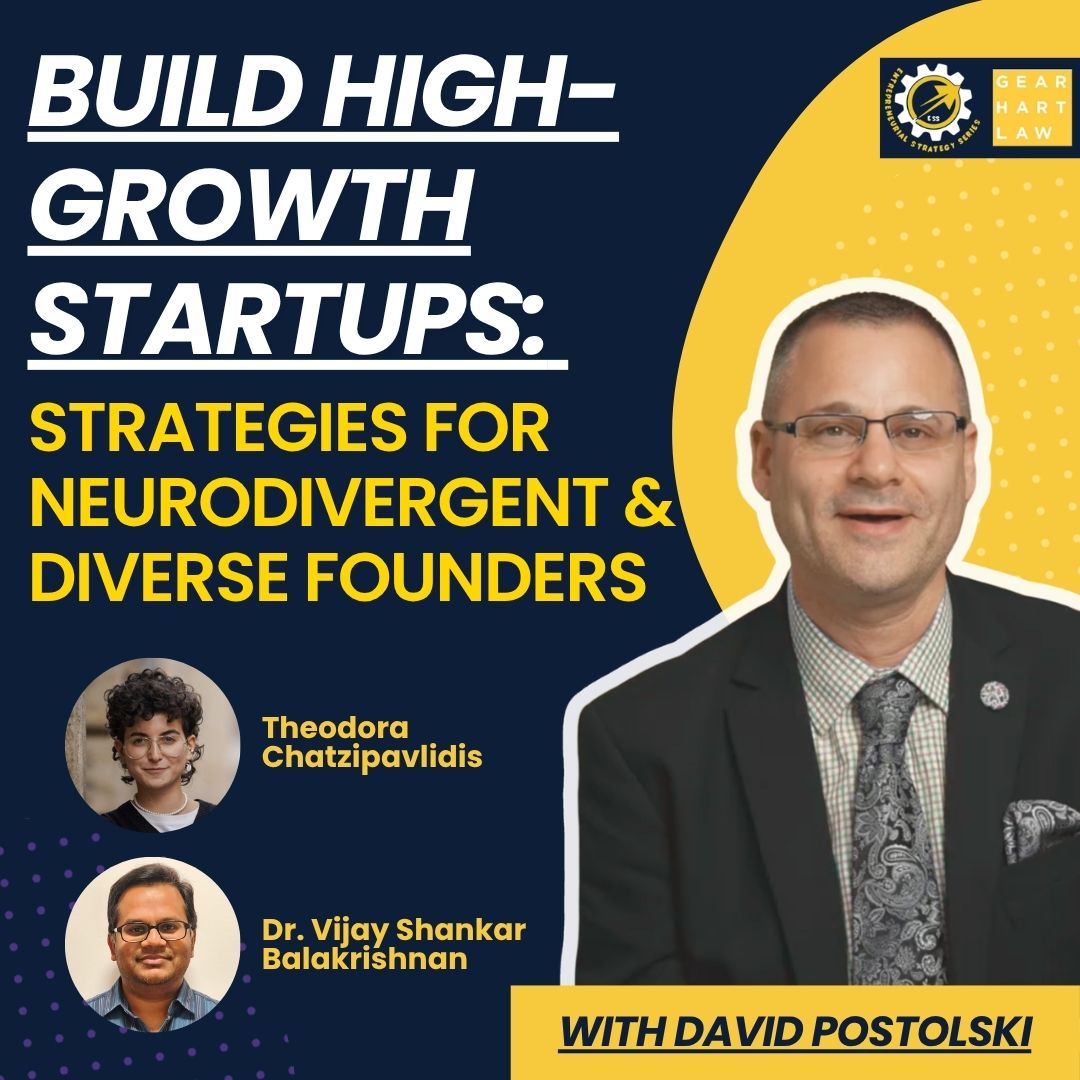
[00:00:00] Speaker B: My name is David Pasalski. I am a intellectual property and patent attorney with a background in chemistry and computer science. I've been an IP attorney for about 21 years.
Started my career at really large law firms and really large companies and decided about 12 years ago that I wanted to devote my life to startups, entrepreneurs and emerging companies.
And so I'm at the smallest law firm that I've ever been at, but probably the most soul satisfying and happiest I've ever been. It's called Gerhardt Law. We're based in Summit, New Jersey, and we're very big, including myself on education and empowerment. That's a big thing. I'm a professor at different universities teaching about intellectual property and entrepreneurship. And so I'm a big believer in making sure that everybody's well informed, which is the reason why we created this series, the Entrepreneurial Strategy Series, about five years ago now. It will then be available on, on. On our YouTube channel.
And it also is a downloadable podcast as well, so you can check out other episodes and stuff. Basically what we tried to do is educate and empower entrepreneurs on topics from concept to exit, and so everything kind of in between. So if you look at our past episodes, you'll see some, you know, really great nuggets. If you have any ideas for any of these future sessions, please let me know. Reach out and maybe we can feature you as a speaker or try to build something around your topic.
I.
This is a particularly near and dear topic to my heart. I've been working with all sorts of founders for the last 20 years, and I've seen all sorts of journeys. I myself am not neurodivergent, but I am a gay male, which has its own kind of challenges in this, in the field that I'm in.
And so it has a personal connection for me as well.
And so I'm really excited about our two speakers.
I'm going to let them introduce themselves.
So I'm gonna start with Theodora, maybe Theodora. So Theodora is our first speaker.
I'm gonna let her introduce herself directly and then we'll move to our second speaker, Vijay, and then we'll kind of get into some topics. But Theodora, please take a moment, let us know who you are, where you are, what you're working on.
And by the way, Theodora and Vijay, I've been listening in for the first half hour, which I'm so excited that they did. So if you have any thoughts about that as well.
So, yeah, go for it, please.
[00:02:55] Speaker C: Yeah. Hello everybody. Thank you so much, David, for inviting me and also Vijay as well. I'm honored because I actually was born in the United States, so in New York, but I grew up in Germany, in the south of Germany. Now I'm living in Berlin, but I'm originally from Greece, so it's a lot of cultures coming together already.
And my startup had actually something to do with traveling. So I, I truly believe your childhood and the way you grew up and things that happened to you are highly influential to your journey. At least it was how it was with me. And I created the startup very out because next to being a founder and next to being trying to find and being myself in so many different layers, I'm also a solo Traveler for like 10 years. And I always find it really difficult not to meet people, but to meet like the right ones that really match your travel expectations rather than you having the same talks over and over again. And you feel like a waste of time spent with people because you wanted to do something else. And that's how we came up with the idea. Well out. So we connect solo travelers based on different kind of layers.
We did, like with psychologists, some research about how to connect human beings, like, better together. So we use technology not to replace human connections, but to strengthen it, actually.
And while doing so, we connect them in the next step with local businesses to give them the visibility they deserve. We find it especially while traveling.
So, yeah, besides that, I was also a professional Greek dancer for like 20 years, which is a random fact about myself. And I was playing like 15 years tennis as well.
Well, my parents thought it's a bad idea to study instead of becoming a tennis player. I had different plans, but here we are today. So happy to be here. And yeah, I think I said it, but I'm located in Berlin. So happy that also some people joined from. From there. So we are in different time zones.
[00:04:51] Speaker D: Yeah.
[00:04:51] Speaker B: So thank you. We're going to hear much more about Theodore. But that was, that was, that was a little sneak peek for sure.
Let's go to Vijay.
Please introduce yourself.
Actually, it's funny, I want to just say that.
So I know Theodora through Vijay and I know Vijay through this ess. He actually attended one and he reached out and so now we're just making history. So go for it. Vijay. Hi. Good to see you.
[00:05:23] Speaker E: Hi, David, good to see you too. And thank you, Theo, for joining and everyone, thank you so much for joining this webinar or podcast. It's also a very near and dear topic to me and I come from India originally. I moved to Germany after traveling into different places, did my PhD from Denmark and then went to UK London to study journalism and put everything together into journalism and communications. And that's exactly what I'm doing right now. I'm founder of Naratrix. Naratrix is a corporate communications boutique. I detest, you know, calling it an agency because it's one of the most abused terms although it's psychologically should not be. And that's exactly what the topic today I want to put focus on.
Yeah, I live in Germany for the last 14 years and naturalized. I hope I have bleached enough my, you know, myself to call myself German. The audacity.
But yeah, I have ADHD and autism which my therapist whom I'm in talks with for seven years has screened. But the German healthcare system really is hard to crack to get the proper diagnosis, certified diagnosis done. So that's one of the biggest problems. And then I'm also an entrepreneur. Why I do what I do is because of my life experiences as a scientist, as a journalist, as a communicator and as part of corporate Big Pharma. What I experience, what I observed, I just want to put everything together. So Naratrix is my ikigai. And being in this room and tuning in the first half an hour, I was really humbled to, to identify myself with a lot of different talents out there who are also, you know, in, in the neurodivergent or any other diversity categories. And we are all doing our best to, to prove to ourselves, you know, more than to anyone else why we are doing what we are doing and why we, why we, why we just keep fighting, keep thriving. So I'm really happy and thank you David for inviting me and thank you David also for being on my podcast which is coming soon by the way and PO2.
[00:07:51] Speaker B: Great, sounds good. But I'm going to stick on you Vijay for a little bit because there definitely were self identifying people in, in the first half hour. But I'm sure there's people in this audience and who might be listening. There was about four or five hundred registrants so they'll be listening to what is, can you, can you break it down for us in your own words? And Theodore, I want you to comment on this also. What is neurodivergent and the word diverse, what's that meaning to you? Textbook or personal whatever it might be?
[00:08:29] Speaker E: To me, I don't really find a proper textbook explanation of neurodivergence. That's to that, that's to, to the best Satisfaction of myself. You know, what I consider neurodivergent. I mean, every, every human being, every life on this, with, with earth, with a brain, we are all diverse in our own way because of thinking and abilities. But what makes neurodivergent a specific topic and an important one is that when all of our, we all have our quirks and when our quirks become our liability and that liability becomes the disability and some disabilities are visible, some are invisible. And most of the adult version of neurodivergence, other than the developmental origin of autism or ADHD or any other neurodivergent aspects, we appear normal in terms of ableist perspective. But we do have our liabilities. And that's, that's where I believe, you know, the divergence has, has a, has, has a very, very volatile definition and discussion. And yeah, that's my take, I would say.
[00:09:51] Speaker B: Okay, yeah, no, that's, that's great. Theodora, did you have anything to, to kind of add to that?
[00:09:57] Speaker C: Yeah, maybe. It's also really interesting to say that I, I haven't, I wasn't diagnosed. I have never done therapy, not because I truly don't believe in it. It's really, really important. It just never came up. I mean, Greek families, they don't really pay so much attention to mental health.
Luckily I broke, I believe I broke like a lot of change and worked myself through, through a lot of things I studied. It's a never ending process. And then I also found the word neurodivergent. And I always thought I'm a little bit different or like, you know, the weird kid that is thinking differently, that wants to do things differently and this not being accepted. I became really, really quiet as a kid and you know, more introverted. And now I'm just living fully myself and I'm the most extroverted person. I can go in a room and talk to everybody. And this is just because I accepted a lot of parts of myself that society told me they're not a, you know, there, there should be height or they should not be here or you should be someone else or follow this guidance. And I always was someone who loves to break rules. Not, not like the rules, rules, you know, but like whatever society tells you, I'm always questioning it and I'm trying to find my own way. Is this the way I want to go or is a different way? And so this was actually my, my whole life. And I'm glad during COVID I had the time to work a lot with, with myself.
And so neurodivergent for me, the understanding is that it's. At the end of the day, everything is spectrum and there's no black or white world. Everything we do is a spectrum. And we try with labels to really break it down and to make it simpler for our own brain and for our own view. But human beings are super, super complex. And it's just a term to see that people who are not fitting in the nine to five, people who are not fitting in the system that were built for.
I wouldn't say human beings even, because the systems are really like, you have to be this way, you have to study this, you have to do this. And I'm really out of. Out of it. And I believe a lot of people feel like they don't belong there or they don't feel different because I cannot do the 9 to 5 or whatever it might be, right, something out of the system.
And it's nothing bad. It's just understanding that how do I work, what do I need and actually how do I see the world and how my brain is functioning and also my energy levels. So it's. Yeah, it's, it's interesting. And also watching my mom, because my mom, 100% she has ADHD and the probability, right, that the kids have it is super, super high.
She's watching TV on, like TV on her phone, something else while reading a book. And my mom is never running out of energy. And I was like, wait a minute, do I think my mom has it and that I dive deeper into it? So, so yeah, it's. It's really broad, but I hope it was a bit clear.
[00:12:48] Speaker E: My view, my discovery was more or less like that, you know, already from my early teen age, I was like, okay, I don't fit in any box that the society or the school asks me to cram myself into. And I was always weirded out and I was always like.
I don't know whether it's a strong word to put it that way. Ostracized, you know, always bullied for being different and thinking different, talking using different words and, you know, all this, you know, talk, talking like I'm talking from the cloud down. That's, that's how people were telling me you were. You are really flamboyant and everything. But yes, that's how I see life and that's how I experience life. And like, Theo, I think I' also been observing my family and there's a lot of mental health issues within the family through the generations, epilepsy and so on. But there must be Some sort of neurological reasons there, but I think mine is mostly social and, you know, due to life experience, you know, trauma and. And being living with people with mental health issues and then compounding effect of your own mental health issues. And at some point you really think that you have figured it all out. And then when you are put in a rude awakening moment, that's when you realize, oh, God, I'm totally fucked up.
And that's when. That's. That's when I realized, okay, yeah, so there has to be a name for it. And some people, they don't want to be labeled. But for me, labeling is like finding a map in a open landscape or a desert. And that's how I see, you know, why I need to be really diagnosed. I've been on therapy for seven years already, for 30 years of experience, trauma and everything. But, you know, labeling helps me go in a certain direction and think about the skills that I need to, you know, really tap into and build the toolkit. And that's how I discovered this vast expanse of universe of neurodivergence. And Theo rightly said it, it's. It's a spectrum. I call it a spectrum, which is also moving mosaic, because neurodivergence is not like you can be predicted.
You know, it's. It's always unpredictable. I don't know myself when I have high energy, when I can focus really well, when I lose focus, when I could be impulsive. And, you know, one. One example is like, when there is really something horrific happening, I would. I would be consoling other people while going through the same trauma myself. But when I'm done consoling others, then I would go in a. Into a separate room, and then I console myself. And that is like a lot of burden. So these are some of the quirks when I, you know, where I realized, okay, this is really not normal. And at some point my wife was saying, I wish I could I have the tool to. To open your brain and see what's going on there. It's like.
It's like a salad of spaghetti or, you know, crisscross wires. But that's where the ikigai identification also came about. You know, why I want to do what I want to do? There are people who misunderstand people like ourselves. And that's why I want to help people not to be misunderstood and take the ownership for themselves and, and how to help them find their voice.
[00:16:43] Speaker C: At the end of the day, the best thing we can do, yeah, go for it once. And the best thing we can do is just being ourselves. And this will trigger a lot of people. 100. Because a lot of people are afraid to break out of their own rules or what they said for themselves or society said it. And the best thing you can do and bring your life energy back is really being completely yourself and dealing obviously in this world. Right. So we have to learn also how to, how to still function in a way. I don't like the word, but still. Right. We know the rules of the systems of society and we still have to play the game in a way, but in our own way. And I think that's, that's the beauty of neurodivergent people, because we can also create new rules, adapt to them, and like, yeah, changing a little bit the path of it. So being honestly yourself is the best thing you can do.
[00:17:33] Speaker B: Well, on behalf of everyone.
And if you read some of the, some of the comments, thank you for that. Just the honest and transparency in your journey.
And so your journeys have both had you create your own companies.
And so I want, I want to talk about, I want to get into each of your companies because they're specifically related to this topic. It's not like you're doing something that's unrelated.
So we'll start with Theodora. Tell us a little bit about just travel in general in your life and what, what's happened. I mean, you were born in New York, you're living in Berlin, you know, you, you.
And you're a solo traveler. So how that, how did all this manifest into the company that you. That we have before us?
[00:18:29] Speaker C: I was shortly reflecting on that myself because I'm a restless person. So if I'm staying too long in one place or do the same things over and over again, I'm getting restless. I feel like something inside is dying.
And for a lot of time I thought, like, something is wrong with me. Like, how can I not, you know, like, other people do the same things every day. Stay there where I was born or grew up in my way.
And now I find it quite nice because that's, that's how I am. I have to move. I have to experience a lot of things I have. This is how a little bit I create opamine, I would say, for my excitement for life, for myself. When I have a lot of unpredictable stuff going on and I'm having the joy to dive deeper into them and experience new things.
So this is also part of me. And this part or a lot of parts of myself, I always try to hide or to say, why am I Like this. Why can I not change? And forcing myself to become somebody I. I didn't want even to become.
So yeah. And this is how traveling actually is the most amazing thing for me to do because I can be whoever I want. People are meeting me for the very first time. So it's also like this free.
You are a lot more free when you go out of your bubble, experience new cultures, meet new people. They're gonna meet you the way you are, what, what you're gonna show. And.
And this is how it also added up to my personality to become more open, to be more curious for the world. And I truly believe traveling has the tool also to minimize discrimination. Because you get to meet people, you don't see them only on the news, but you're actually experiencing them. The culture, the people, new places. And you getting out of your bubble and see that, hey, actually also not. I could also live a completely different life.
And this didn't started when I started solo traveling 10 years ago. As I said, my parents are also a little bit crazy. So they gave birth to me in New York because they wanted to move to the States. I think it's a really common thing to do. I don't know if I can say that out loud, but yes, it was a plan.
At the end they didn't move to the States, but I got the American passport and they always traveled. The one thing my parents really did is spending money on traveling on experiences. We have five kids and we never stopped. Like I don't remember like any year that we haven't gone to travel. And it's not that we are that we're like living the luxury or rich life. It's more that my parents never hesitated to spend it on traveling. And this is how it influenced all my life.
And when it was not cool anymore to travel with your parents, right. And I wanted to go and my friends didn't have time. I started solo traveling, which was super scary.
Ending up in really weird hostels. Having also the best experiences. Feeling lonely, unsafe, life changing experience with other people. So we experience so many things.
And that's how I came up with fail out during university. Because my professor told us to focus on our own problems and because I wanted to enjoy my.
The last semester of my studies, I was like, okay, solo traveling. Let's try to find a way how we can actually connect better.
And then I just kept going because it was fun, it was exciting, it was something new. I couldn't predict what I will do in a week. But um, so also entrepreneurship is something I truly enjoy doing, even though a lot of times I have mental breakdowns, I want to quit everything. And the next day I'm the most happiest and motivated person in the world.
And that's nice because I can go through all my emotions in this journey, and each of them is teaching me something that I wouldn't change.
And then at the end of the day, it's also a question to us with who, what I'm okay with, what compromises and with what I'm not okay with. So I cannot tell a person to do the same thing that I do because they have to be okay with their decisions, and I have to be okay with my decisions in life at the end of the day. And. And that's the most important, like, thing. So, yes, we gotta continue the journey with Veglot and I gotta keep continue traveling. So I'm also on the app, by the way, so if people met with me, we can also have our little trip together.
[00:22:58] Speaker B: Awesome. Awesome. Thank you for sharing.
Vijay, you've also turned your.
Excuse me, You've also turned your neurodivergency into a superpower with your company. Can you talk a little bit about that?
[00:23:12] Speaker E: Definitely. So the neurodivergence, the realization, or, you know, in my case, my first depression was my own diagnosis before I went to my doctor. And that's how I realized that, you know, after reading Gabor Mate, the Myth of Normal, it was like, okay, I. There is something that I can put my condition or this quirkiness, a name. You know, I call myself Buckyball in this case because there's a lot of spikes going in different directions.
And.
And that's when I realized, okay, what can I tap into? And this realization came about around the time of my PhD. So I was doing my science PhD in Denmark, and I had.
I was enjoying the process of creating knowledge through experiments and everything.
But at the same time, I had a very strained relationship with the team. And it was probably also because of my neurodivergence and also from their side. It was very hard for them to decipher or interpret the kind of person I am, the personality and how to work with and so on. But still. Still, I. I managed to complete my PhD. And then when I was writing my PhD dissertation, I did something that really only rarely people, if not anyone, no one would do it. You know, I.
It was like two, three weeks before the deadline, and I really wanted a dopamine boost to start with the writing. And what I did was like, read all The Harry Potter books, one to seven in one week.
Yes, I did. And that gave me a lot of dopamine rush motivation. And then I started writing my dissertation. And within two weeks I completed writing it and I really got good comments. And that's when I realized, okay, when I look back, I started writing short stories and poems already from teenage and where it came from. I would say it's all from my parents and the family because there are lots of stories.
I always think that every person has a lot of stories.
How we see them, how are we going to tell them? That's where we all differ. And my father has had his own story. Him moving from a village to a migrant worker in Libya and working there in the desert and met with accident and so on, and the journey of him making his own life. And then my mom, who lost her mother when she was 2 and lost her father when she was 15, how she coped herself up and waded through the life and how they brought together a life that was both plus and minus, like anyone's life. And then I saw my parents using whatever they had to build their journey. And both of them were entrepreneurial.
And I think that sort of ran in the blood.
And then at some point I realized, okay, I was able to write stories. I always loved stories. And I connect with people through stories.
So why don't I make it a living? And at that point, like any other Indian son, I was, you know, being molded to become either a doctor or an engineer, if not a professor.
And that's why, you know, I didn't get to become a medical doctor, I didn't get to become an engineer.
Don't ask me why. That's a separate story in itself. And then I ended up doing my PhD, hoping I would become a professor, but I didn't.
In its own remit because, you know, if you have strained relationship with your PhD supervisor, then you can never become a professor. Forget about it. And that's when I switched careers. You know, I went into science, journalism and communication. And as a neurodiver, divergent.
I started really stupidly or boldly. You can decide which, which word you want to choose. For me, anyone going into journalism would start with some sort of internship or contact or anything. But I did scratch from the scratch. Nothing. No contacts, nothing. I started doing things myself, learned a lot over the time. And then that's also the point of being a neurodivergent. You know, there is superpower, yes, lots of ideas that you get. You know, in one minute you will get about 30 ideas, that's minimum.
But can you execute all of those? That's really impossible.
And it took time to tame all those ideas and how to shape them up and then put those together into, into some sort of package of offers. But also not in a way that, you know, unicorns do or big corporations, you know, big corporations who do unethical stuff. Not every corporation, but those corporations that do unethical stuff. I don't want to be that kind of person. So it's like finding a purpose and then using my skills, using my experience. And what I observed as a journalist is this is where it becomes my business.
I, I was in a journalism class.
Prominent BBC journalist who is also a trainer for other BBC journalists. She was training us for, you know, news and documentary style filmmaking and then portrayed one film, short film. And that was an award, award winning film. And that was about rack pickers, electron e. Waste pickers in Ghana. And it didn't feel right to me. Yes, it was a problem. It is an environmental problem, it's a social problem, it's a human rights problem. But the way the story was portrayed, I called it, I think many people who see that kind of stories, they would say it's a poverty porn. Poverty pornography? Yeah. So that's, that's, that really disturbed me. I come from a developing country and I know the layers that are in this society and how certain class of media portrays certain stories. That's because, you know, the, the people who are being featured in the story, they don't have the story ownership, they don't have the narrative ownership. Whatever they are told, whatever the journalist perceives, they tell that and portray that to the world.
So the complexities of human beings, the complexities of stories, when it comes to business, when it comes to people setting aside their time, their money to buy your products or services, when, when the complexity has to be relatable or simplified. And in there is only one way to do it. Storytelling. Emotionally connect with people.
And in case of business, people buy from people and people connect with people in a way it's like, you know, I always ask this question in my workshops. What do you think people remember?
Do you remember people because they made you think about something? Or do you think, do you remember people because they made you feel something about.
And the all the answer is always feeling. And feelings are also what, you know, helping people reach a decision above and beyond any cognitive decision making process, thinking and so on. And there has to be a balance and this narrative ownership and preventing narrative or story. Hijacking and then how to tell people the stories that, that will help them establish their credibility, build their reputation and at the same time become a successful business.
That's really a complex nexus. But storytelling makes it easy. That's the medium and that's how I came about using this whole experience derived neurodivergence into, into storytelling. And why startup?
I work with startups because, you know, as a neurodivergent, I get easily bored. If I do the same thing over and over for more than six months, then I'm really bored. I really need a lot of new things to do. And associating myself with startups means I get to experience the ups and downs of the startups and also the various functions within startup communication, startup storytelling. That is really exciting and that never bores me. And for one reason I think it always keeps me going. I, I work like 14 to 17 hours and then I had to stop myself from going into burnout. But aside from that, this is how I, I, you know, discovered that all my experience, all my neurodivergent superpowers and flaws and everything can be packaged into helpful offers in a way that, that helped me, myself and also others. That was a very long winded answer, but there you go.
[00:33:00] Speaker B: We appreciate that.
Okay, let's talk business.
You both are entrepreneurs.
There's definitely a lot of entrepreneurs here that are self identifying as new neurodivergent. Can you talk a little bit about just business in general? How is your experience? Theodore, we'll start with you. How is your experience benefited or not benefited from being neurodivergent? Have you weaved it in to your business pitches and stuff like that?
Maybe you can talk about that experience. Have you, have, have you, have you been open and honest about it like you are today? Or has it been a little bit of hide and seek? Maybe you can, you can discuss.
[00:33:45] Speaker C: I mean I'm, I'm also a queer person and there was a lot of times where I was just hiding myself. So I guess we came into a time where hiding is not the solution anymore, but more representation and being out there and yeah, just talking about, just like again, as I said, I was never diagnosed and at the end of the day I'm not there to put.
I know labels are important for a lot of people, but I'm. Maybe it's the Berlin, right? Berlin is also a special place to be. So there's also something about not putting any label on yourself and just being yourself, but understanding who you are and what are your superpowers. And whatnot. And for example, networking, talking to a lot of people, A lot of people get like super drained super fast. I can be on networking events every single day and be like more energized when I speak to the right people and have like really awesome conversations and connecting points.
So also realizing those kind of superpowers, right, that everybody has, no matter in what spectrum you are, everybody has superpowers and that you can use them to your advantage. And if you, if you know about them, it doesn't mean to exactly define yourself, who you are. But still being open for four changes, but also, for example, pitching to investors or having a demo day, it's easier for me to connect the dots. It's easier for me to tell the story, to create the storyline and then come back to what I said and connecting. And it's easier for my brain to function like that instead of just learning everything by heart. This freaks me out because my brain then cannot stop thinking about the next sentence and the next sentence. Instead it's, it's easier for me to know, to have a little bit of a guidance and then target talk about my story at the end of the day and, and create like a pitch the way.
With the, with the guidance obviously, but the way I want to say it at that specific moment and it really changes the beginning of my pitch, the beginning of our startup to now, the effect that has some people for sure and at the same time this flexibility.
Vijay also mentioned it. And I think for a lot of people you have to know that you have to work a lot, right, in a way to build everything from scratch by yourself and hopefully with a co founder or not, it's working a lot of hours and then it's how you manage it. And the good thing about it in a way is if you're motivated and you know why you're doing it and what is your motivation behind it, you can really thrive and you can make the breaks whenever you want. You can start your day whenever you want, end your day whenever you want. And this flexibility, I don't know, gives me the freedom to, to keep pushing.
Even though I saw like a real recently said I don't want to do 9 to 5 because I don't want anybody to tell me when to get lunch. And now I became an entrepreneur and now I skip lunch because I don't have time for it. So this is kind of the reality, right? We are making fun about it, but this is also a way what kind of systems you build for yourself that you can work better with instead of just going into a corporate world and the systems are there and the rules are there and the structure is there and if you don't fit in then you are, you are the weirdo and you are the outliner and you might be fired. But if you are in this entrepreneurial world and you build something for yourself and hopefully for others is you can create those systems that fit best for you.
And so this is something really, really, really helpful for myself as well to yeah find what works for me and what doesn't work for me. And sometimes I have those nights where I work during the night and that's the best time and sometimes I, I wake up at 6am and sometimes I sleep in until 10, 10am and then I start my day. And so it, yeah, I don't know, it's a weird freedom even if you work more hours, if I can say so.
[00:37:45] Speaker B: Yeah, yeah, I, I, I, I, I definitely think being an entrepreneur definitely comes with certain freedoms for sure. So that's great. Vijay, what about you and like building your business?
How is, how is your neurodivergence helped you, hindered you?
What do you think?
[00:38:06] Speaker E: So in my case it was a bit difficult to identify what my business model was and so on. And then I accidentally got introduced to a business coach. She has ADHD herself and she helps people, business owners with ADHD identify their strengths and find a business model and you know, help them establish the business themselves. And that series of sessions with her for one year helped me really well. So that's when I realized, you know, whatever I was feeling really awkward to put tell about myself out there, I can convert that into business without tokenizing my experience and I can, I can really turn the table to the other side and say okay, if I can do that, you can also do that and I have the toolkit, I'm helping you with that. So that's how I, I started doing it. So there is a list of questions from someone on the chat about a lot of different things about business and especially focusing business as a neurodivergent person.
We need individual sessions to answer each of these questions. But at the very top, high level or off the top of the head, what I did as a servicepreneur scalable business model came from what I know, what the economic trend is, where I can contribute from what I know and what can make me money and whether I can find actionable solutions there, whether I can package them into offers.
That's the first step. Once you identify that then I think the next Step is the next steps are relatively easier.
So in my case I have a lot of frameworks and I have built my own frameworks as well. And one of the frameworks I have is what I call the civic sense.
So basically every person has civic sense in, in the social, civic perspective. But also like every person is normally clear about what they want in their life in general, and then where they want to belong and where they want to be known for, and for what, and whether they can make money out of what they know and where they want to be known for and for what. And that framework, the civic sense, helped me categorize where I want to help. So in my case, corporate communications is where I started with this startup communication idea. Whenever startups think about communications or telling their stories, they always think of it either only at pitching stage or later at marketing, sales and pr. But there is a lot in between before pitching and beyond pitching, but all the way leading up to sales. This upstream storytelling is a huge gap and a lot of founders make or inherit the same habits from corporate communications in big corporations. And partly also to blame the VCs and so on because they guide how to communicate, what to communicate and so on. But the trend is changing. I spotted that and I think that's where my neurodivergence also helped a little bit.
And also having been a journalist and really quick in identifying trend and I just, just joined that right. And then developing a compelling pitch, that took time. And I would say this is an ongoing process because every time I pitch my business to someone, even if it's in the same room, if I'm pitching it to different people, it would be different because I would first gauge what the other person is interested in or leaning into. And that's how I tune my messaging to them. So that's how I develop my compelling pitch and that's how I help people craft compelling pitch. You know, first know the audience, what they need, what, what helps them decide and give them what they need to make the decision for. You know, decision making is a process and pitching is like basically giving you give you, giving them the information to dec whether to buy your product services or whether to invest in you. And that is a process in itself that one needs to keep practicing and keep doing it and navigating fundraising grants and alternative financing opportunities. So I'm not a techpreneur, I'm a service preneur. But working with a lot of startups and entrepreneurs, I can say that
[00:43:11] Speaker A: it
[00:43:11] Speaker E: is becoming more and more difficult given the state of Economy and climate change and preferences in funding and going in different investment directions like in defense and so on. You really need a strong argument. What, what is it that you are really trying to solve? Whether it is a painkiller or a vitamin and if it's a painkiller, then compare that painkiller with other painkillers out there and why your painkiller is better than the others.
And that's when fundraising becomes easier. As for grants and alternative financing opportunities, as for Germany and a little bit about Europe, I'm aware that there are non dilutive funding opportunities.
So one can identify those opportunities in your respective countries or regions and then see how you can navigate that bureaucracy and how to get that, you know, you supporting your business and turning different ways of.
Sorry. Building inclusive and high performing teams and partnerships. Wow, that's an MBA in itself. But inclusive team.
I like to treat people. I, I like to be treated with respect and I like, I want people to respect boundaries and not gaslight me if I expect that. Also need to treat other people the same way and just, just being empathetic and finding the right people through networking, physical networking, in person networking and digital networking on LinkedIn. How you come across and how other people come across to you and interacting with them, that is one way of trying to identify your team. But there are also different ways to do it. If in Germany people are encouraged or allowed to hire student interns even on an unpaid basis. So if there is options like that for you in your respective countries, of course you can explore that.
Turning different ways of thinking and lived experiences into a competitive advantage. I think that's something I have already talked quite a lot about and I don't want to be redundant. Accessing resources, networks and support designed to help founders thrive. That's a very broad question. I think everyone can participate here. My way is networking and then putting myself out there, making myself vulnerable, telling my stories, telling why I do what I do and finding opportunities like this podcast or offering workshops and introduction introductory pro bono workshops.
That's how I make myself visible. And I'm building a podcast and substack myself. So where I also bring people and it's like mutually helping. You know I brought Theo and David and now David brought me here. It's like the age old blog rolling now you can call it podcast rolling or anything. So that's from me in a nutshell.
[00:46:13] Speaker B: That's, that's great. And, and, and I kind of want to say like and I. And, and I feel pretty strongly about this that hearing Other people's life stories is the best way to learn, period. The end the story. We don't even have to talk about it anymore. Tom Wynn, you had a question. Do you want to ask it live?
[00:46:36] Speaker A: Sure. Yeah. It wasn't really a question. It was just kind of a general note of things here in the US One of the interesting things about kids is that they actually wear their ADHD diagnoses like badges of honor. Now they do this, you know, like I children in elementary school. And what's, what's. What I find is happening is it's the old idea of ADHD being a stigma and something that is, like, limiting and like some kind of disability certainly is true for some varieties of it. But by and large, in today's world, in my experience, and my recommendation would be not to. Unless your business, like, relies upon, like, some sort of, you know, dealing with ADHD or autism or something like that. My advice would not be to lay it out as part of your identity, you know, like, unless you get to know the people very well, in which case then it makes a lot of sense. But my advice would not be to throw it at them initially, because I don't think it's. It's viewed as a. As a stigma so much as it used to be.
And then the second thing I'd say is, like, if you're trying to figure out how to use your ADHD to help, you have just open up when you get in the car or something, or when you're on the tube, open up several voice conversations with an LLM. Tell it what your goals are, tell it how your brain works, and just have an ongoing conversation with it. And eventually it will help you create a system or an app or anything, or recommendations of, like, which medium to use. Are you a pen and pencil person or are you a typing person? But you can just talk to it and tell it what you want to find out, and through the course of that conversation, it will design a solution for you that you will feel really good about, and it's not hard.
So I would just suggest everybody give that a try. You know, have multiple conversations with an LLM, talk about your growth strategy, what's my fundraising strategy, how do I do task management? How do I keep myself accountable?
You'd be amazed at how intuitive these systems currently are. So that's my recommendation.
[00:48:37] Speaker B: Theodora, many comments.
[00:48:40] Speaker C: Actually, I'm doing that. So thanks for mentioning that, Tom, because the most important thing is to know yourself, right? In order to talk also to the elements and to build the system for yourself better. And in order to know yourself is also to accept like both sides, the good and the bad sides, and to be completely honest about it with yourself. You don't have to have to tell anybody if you don't feel comfortable, but at least you can tell it to yourself because nobody is perfect and we all have our flaws, but we can work with them. And I also would never. I mean what I also see sometimes is people saying I have this or I have that and then they don't change and then they're like just, I don't know, taking it as an excuse. I would never take something as an excuse when you know something about yourself. But that's the way you can work better in this world also with yourself and for yourself. So never take anything as an excuse. Or at least this is what I'm not doing right, but work with it better. Yeah, the system was not made for all of us. That's true. Is life fair? I don't think so. But we can still thrive in using maybe LLMs to create our own ways, our own systems. And yeah, maybe for some is entrepreneurship the way, for others not. And that's also totally fine. There's no blueprint in life and nobody will tell you blueprint. But there are a lot of tools out there that you can use for your own advantage, hopefully. And yeah, to make life more and more enjoyable.
And yeah.
[00:50:08] Speaker B: PJ, any comment on what Tom said?
[00:50:10] Speaker E: Sure. LLMs are quite helpful and I live with Claude basically and Claude is my coworker, but a coworker whom I can hand over the tasks that I have a control on. When I have to seek advice from LLMs like Claude, I.
I'm really careful even if it produces a lot of structured, although really helpful sometimes arguments and resources. But I don't take it just the way it gave me because, you know, to go back to my origin, I don't fit in any of the boxes and LLMs usually bring you the same boxes that you really don't want to be in. And I've realized that most of the times and I use that as a research partner and get me information like a thought partner and then find out my own way, draft my own version. And that has only that has helped me. So LLMs are like directions or maps and you need to decide where your destination is and whether you want to digress yourself into other parts. I think it depends on your energy level and other resources that you have at your site. But LLMs can be really helpful.
Only you would know what you want to do with your skills in life. And if that destination is clear, then the paths can be in any direction, any way, and created with multiple tools.
[00:51:47] Speaker B: Awesome. Love that. If anybody else that has a question that they want to ask live, please raise your hand. Carol, let's add you to the spotlight.
[00:51:57] Speaker D: Hold on. Thank you. Well, I wanted to comment about Tom's comments because he talked about kids. And for women, particularly above 40, the expectations that we have in defined role models makes ADHD not something that we brag about. It actually has a significantly higher divorce rate because we're expected to remember to pick up the kids on time, to accept phone calls from our male colleagues or partners. That said, prepare for a dinner with my business partner in two hours.
And things like that are just beyond our scope.
So I'll speak personally. I mean, I was 70 when I had a label for my condition. And I'm one of the most aggressive business people that you will meet. But it took me five years to even be comfortable whispering the conditions to my closest friends just because my biggest challenge is clutter and not finishing projects.
When I get 80% done with something and I can see the light at the end of the tunnel, the challenge is gone. So I am off to the next bright, shiny object.
But I do agree with Tom about whether advertising it. You have to be very selective in terms of the work environment that you may be in. Because a lot of people, you know, would write you off in the promotion chain.
[00:53:30] Speaker B: Yeah, yeah.
[00:53:30] Speaker D: Just because of the lack of understanding.
[00:53:32] Speaker B: Exactly.
[00:53:33] Speaker A: That.
[00:53:33] Speaker B: That's because 100. And that's with. I think. Yeah, that's with any sort of quote unquote label. Unfortunately, we're still in. In a place like that. Vijay Theodora, want to comment? Anything Carol said.
[00:53:47] Speaker C: I like what you said. Also. With this 80%, the challenge is done, and then we move on same. I mean, I have 100 million ideas. I would love to have 100 million people to execute on them, because I really have a problem with prioritization, and that's really horrible sometimes. So I'm. And some things come up and I switch my whole calendar and I'm like, no, this is now important. And then I really have to remember myself and to set up a goal for the week. This is my new system. What do I have to really get done done and what else? If it comes up, I can manage in a way to really, like, I have to discipline myself in so many ways. Right. Because it's. It's hard to stay focused. A lot of times it's better to jump into something more exciting than to just get the things done that need to be done, even if they're not the most especially bureaucratical stuff or the 20% of the, of the end of the tunnel.
So yeah, it's definitely also hard sometimes. So we have superpowers and we have those things that we also realize we are in our own way at the end of the day.
So yeah, even around them to know that there will be comfortable times and uncomfortable times and things I like to do, but I also have to do the things that I don't like to do.
[00:55:00] Speaker D: The example I use is the guy who started 1-800-JUNK here in the US which is a When the honey do list during COVID was 20 years of collections in the attic or garage, the first thing he did was hire an operations executive because he had absolutely no interest in the details of what color of the truck's going to be and talking to customers and scheduling truck deliveries.
And that company has been extremely successful because they are a true partnership.
[00:55:35] Speaker C: Just love to do those things.
[00:55:37] Speaker D: Yeah. Because that, that last part, which is when the revenue starts generating holds, holds no attraction to a lot of us.
[00:55:47] Speaker B: Well, on, on that, on that, on that note, you know, be.
People have often said that being an entrepreneur is lonely.
You're doing this, you're doing this yourself. Can you talk a little bit about.
And I think, and I think Theodore, you kind of touched on it. But Vijay, maybe you can, you can, you can start.
Are you doing this by yourself? This, this, this, this journey and, and, and, and is that the ultimate goal or do you want to, you know, hire other people? And like what are those people?
You know, like what are some characteristics that you're looking for in those people to maybe kind of help you with, you know, with kind of building your companies? Maybe you both can talk about that, but we'll start with you, Vijay.
Sure.
[00:56:39] Speaker E: At the moment I'm a solopreneur. I.
The reason why I registered Naratrix as a company is to hire people to work with people.
But me not being a techpreneur, it's not easy to find a co founder and service businesses are, are not as glamorous as tech businesses. That's, that's the first reason. And then the second point is yes, I've been working briefly with someone who has been an intern and now he had to resign because of, you know, him, his studies coming to an end.
But down the line, yes, I would love to work with people in, in the capacity more like you know, whichever tasks I, I am not able to do it. For example, paperwork and then the German tax work and accounting work, my goodness, I really don't want to take care of those. So I really would like someone in the CFO capacity. But I'm in talks with a cousin who promises me to help and then I'm also in talks with my sister to become a co founder. That is also happening somewhere down the line.
She's also in the same business, just just a little bit down the funnel. But other than that, I like to coach and train people and the intern who was with me, he was really quite receptive and he was also, you know, quite open to constructive criticism. And then I told him like I see you like I was your age and I'm like 16 years older than him. And it was really nice to see that as, you know, me being kinder to my younger self. That's a lesson I really learned through my therapy years because you know one, one thing that was really drilled down maybe culturally or also because of the neurodivergence is that, you know, always having self doubt and a lot of pressure on myself and too much expectations and so on. But being a leader, if you do that, I think you will be the most unpopular person and I don't want to be so. So the therapy has been helping me how to treat my younger self. And when I work with someone in that age with that capacity I was 16 years ago, then I would definitely treat them with, with utmost care, much more care than I was to myself. So that's my approach. And yeah, I would really like to work with more people at the moment, my colleagues or the clients. And you know, whenever I conduct events, I conduct in person events. In Berlin I have a series of Naratrix community events where I offer workshops for job seekers and students to help them upskill, you know, upskilling themselves. And also people have heard about employer branding from the employer side, company side. And I'm trying to promote and educate people on the job seeker branding because digital network and in person networking in the difficult job market you need to really up your branding and there are really ways to do it and people are doing it really well. And nowadays networking gets you job with higher chance of getting a job than just applying for a job. So that's one community service that I'm doing.
So there I'm working with multiple people. I really enjoy that. And how I met nice people is like I have to give this example of how I met Theodora Theo.
I went to a summit in Berlin in November last year. And then Theo conducted a very, very memorable workshop which is like connecting beyond business cards. And that's where all businesses are and should be about. And we really connected beyond our business cards and that's how we came about, about, you know, me inviting her to my podcast and yeah, so I, I believe in connecting with people for, for purpose, but not for gains. There's the difference. So that's about it.
[01:01:12] Speaker B: Awesome. Theodora, same question.
Are you, are, are you are, are you still a solopreneur? Are you building your, your, are you building and scaling and like, like, what does that mean? Like in terms of the people that you're trying to look for?
[01:01:30] Speaker C: So I, I started the idea by myself during university, but then I continued found another co founder, then another co founder a year later which was, which is right now also my, my current co founder and CTO on a network event. So really you never going to know where you're going to find your co founders. What I met literally on, on the nightlife. So it's also a funny story. We connected because he's from Greece, I was from Greece. And so really those serendipity moments you can only create when you put yourself out there, no matter how scary it might be for you and be open for any opportunity coming your way because you never know what's, what's going to happen tomorrow.
And so right now we are two co founders. Because the one left at the beginning of last year, he wasn't doing really good mentally and it was getting way too much for him. He underestimated how it can be myself as well. But now I'm here and I'm like, okay, what if it works out right? You have to be a little delusional and crazy in a good way as an entrepreneur as well to continue this journey where logically it doesn't make sense due to probabilities, but you're just like, I don't know, excited about it to see what if it works out.
And then we open position, internship position last year because I felt too overwhelmed by doing everything besides writing code. And we had a lot of applications. So we hired four interns.
One was awesome, one was good and the other two were no great.
Then we hired seven interns there like until mid of August.
It was a lot of managing too many people. I underestimated again.
And at the same time I wouldn't know what we need. How do we work, how to build structure future if we just didn't try out? Because I stopped overthinking things. I'm just now executing on ideas that feel kind of right and hopefully sorting out a little bit better in my mind.
And it feels great working with a team because you're like, how are those people also working on my vision? Like, and it feels great.
I mean, we are remote first company, but we are sitting in a co working space where most of our interns are in Berlin as well. And it feels nice. It feels really great. And it changes this loneliness that I was actually feeling. I mean, we're trying to solve the loneliness of solo travelers by connecting people.
And as my young age, I was feeling a lot lonely. So somehow everything is interconnected again. And feeling lonely in the startup journey, it's really, really common. And I'm great. I'm glad I'm having a great co founder where we check in every. Almost every day with each other. I mean, it's like getting married without getting married.
And you should trust your co founder a lot. You should really be able to talk about everything, about the good and the bad things, because it makes the journey easier.
And at those co working spaces, I connect with other founders and exchange the challenges. And this is really helping me. Instead, building alone in my home, not talking to anybody, it really gets also dismotivating, motivating myself when I do. So. So, yeah, it's definitely a lonely journey, but not always. And you can't create those connections when you put yourself up there.
Yeah. So I don't know if I would continue building if I would be a solo founder. Probably not.
But yeah, it comes and goes with waves.
[01:05:06] Speaker B: Yeah, yeah, of course. Well, thank you. Thank you for sharing. Anybody have final questions for Theodora and Vijay?
If you do, raise your hand. Now's the time because we are getting close to the finish.
And so if. If I don't see any questions and we're just gonna go. We're just gonna go to final thoughts. So Vijay and Theodora, just final thoughts maybe that you can share for everybody listening.
Vijay, we'll start with you. You know, just kind of final thoughts, just, just on the topic in general. Oh, we actually have a question if you want to. Just one second.
Maram, go for it. Want to put. Put yourself on video and ask the question.
[01:06:00] Speaker D: Hi,
[01:06:03] Speaker C: can you hear me?
[01:06:04] Speaker B: We can hear you.
[01:06:06] Speaker A: Awesome.
[01:06:07] Speaker C: I'm Mariam from Chicago.
[01:06:08] Speaker A: I'm an.
[01:06:09] Speaker C: An architect and I'm trying to run my own business.
So I have a question about committing to your.
Your calendar. I have a fantastic calendar, but my ADHD and like, all of those thoughts and like exciting ideas drive me away from them and it's hard to commit to it. And I have a companion notebook. I call it my companion notebook. I write down everything like that I need to do min, like literally like move the laptop. Not to that extent, but you know what I mean? Like, let's send this email with this context, like super detailed. And yet I failed to like commit to it. So I want to know how you guys are committing to your calendar.
[01:07:00] Speaker E: I can share my experience. So I was really bad at it and at some point I realized it was giving me, you know, panic attacks quite frequently and then burnout. So what I decided is like two and a half days during the week, no meetings at all, and focusing only on the to do list.
And I would say I'm.
I have the same level of satisfaction of having to tick off the to do list.
Like I would, you know, eating really, really nice food, you know, that, that kind of satisfaction. So that I think I. That's also an inspiration I see on, in my wife from my wife because she, she is a to do list lover. And every time she ticks off the list, she talks about it really with euphoria and so on. It's like, okay, then I let me try it. And this blocking the calendar for focused activities and checking off the to do list, that really has helping me. And I also learned to set boundaries, you know, boundaries to myself. You know, yes, there's umpteen number of ideas, there's a lot I can learn.
How many of those am I going to execute and whether they can just be part of the idea database. It will be. And then at some point I will share it with someone talking to them during a networking session and they will, will be happy getting that idea. I mean, not every single idea that comes from my mind has to be my IP unless I execute it.
So then until then, I consider this more like, you know, thought bubbles going out there. To you, it would sound really meaningful only when the bubble freezes or when the bubble really becomes something meaningful. So I learned to accept that as well. And this coaching, the business coaching with this ADHD business coach really helped me.
So I, I've been practicing all, all those aspects and these are the two main things that help me.
So I would recommend that podcast actually. So ADHD ish is the name of the podcast. So if anyone wants to listen to it's really actionable tips.
Yeah.
[01:09:23] Speaker C: Thank you.
[01:09:24] Speaker B: Dora. How do you control your calendar?
[01:09:30] Speaker C: So every Sunday I have to say I'm looking ahead. What I have to do and then like I'm planning like my whole week on, on Sundays. I don't know. This became like a return and it makes me easier to start the week because I know actually what I have to do like every single day in a way. But for me it helps to put like blockers so my whole day is actually blocked with different kind of tasks so I don't lose my focus. This is helping me actually not losing my focus because in my mind I would do so many different things and jump from one to another. So at least if I know, okay, one hour for, I don't know, influencer outreach, okay, I have one hour to do so. And I also put myself like a timeframe, right. So I put myself already like a little pressure that I have to do this in one hour. If I don't reach this, another appointment, another task is already there or like going to co working cafes and not bringing my, my charger with me because I know, okay like two or three because I'm running really fast out of battery. I'm like okay, two or three hours, I have to get those and these things done. So I put pressure to myself not to an anxious way but to where you know, where I can deal and work better and more efficient. So knowing my tricks in a way is helping me to get my things done. And it's also like asking myself okay, what is this contributing to what KPI. I hated KPI's until I realized we have a team and I have to create KPIs and yeah create different kind of tasks. And it helped me me the need to create the structure. It helped me for myself to have a better structure and to understand my priorities way better.
So yeah, and it changed from and sometimes ad hoc come up and I'm yeah being like okay, I have to do something else the whole day or I'm actually more dismotivated so I do more exciting things that day that I would do maybe tomorrow. So I also play around a little bit with my own calendar depending on my energy levels and on the priorities. And that's a good thing about, about having your own business because you can do that.
Yeah.
[01:11:35] Speaker B: Awesome. Thank you for your question, Maram. So let's get back to final thoughts.
Theodore, we'll stay with you. We'll end with Vijay. So what are you just final thoughts to everybody listening and you know kind of about this topic.
[01:11:53] Speaker C: I would say the most important thing that you can do because there's a lot of opinions out there, right. Everybody knows it better and Everybody has their own opinion and wants to share it always.
But always believe in yourself, no matter what other people say. There are so many stories where also reaching out to investors didn't work out, right? And at the end person didn't stop. Like the canvas story, for example. And one of the most famous entrepreneurs, female entrepreneurs in the world. So please give yourself, make yourself a favorite, believe in yourself and in your own abilities and you're enough and you have the skill sets and sometimes, yeah, we have to kick our own assets to move on and that's okay. And sometimes if we need rest, take the rest. But never give up on your dreams, on yourself, and never stop believing in yourself. This is the best thing that you can ever do. No matter what the world tells you to do, or no matter what the world tells you who to become, you have to live with your decisions at the end, the day of, of the rest of your life. Right? And life is too short to not live the way we want to live because people will always talk. So if you do your thing or if you don't do your thing, people will always talk.
And yeah, that's, that's my advice.
[01:13:04] Speaker B: Awesome. Thank you so much for that, Vijay. Final thoughts for everybody. Listening.
[01:13:11] Speaker E: Be kind to yourself. That's, that would be my first point because especially for neurodivergent people, we probably because of our exposure or because of the neurological condition, whatever is the reason we have really high expectations on ourselves and probably unrealistic goals or anything. So try to find a way to be kind to yourself and make sure that you have, have the right kind of influence and that you are putting yourself in the energy space and the time space where you can make the right kind of choices, where your consequences don't come back to bite your back.
That would be my, you know, takeaway because I tell this to myself and I tell this to my son as well. So. So only three things matter in life. Yes, there are lots, but everything can be boiled down to three things. Influence, choice, and consequence.
So even if you have good influence, you can sometimes by mistake take a bad choice and there could be bad consequence and a lot of different combinations possible. But whatever is under your control, take the good influence, make the right choices so that the consequences become some rewards and not baggages.
And I try to live that, live up to that and live that by myself. So that is helping so far and I would recommend the same to others. So be kind to yourself and just be aware what kind of influence, choice and consequence you want.
[01:14:53] Speaker B: Awesome. Amazing. Thank you so much.
I. I feel like we can talk about this topic forever. And I do think there's many people here that want to continue the conversation. So please do reach out to Theo and Vijay and continue the conversation. Thank you for, for, for. Thank you to both of you for your transparency, your honesty, awareness, education, empowerment. I really, really appreciate it.
We will be back next month, the last Thursday of August. It will be a session all about AI and intelligence, intellectual property and some other stuff. And so look out for that and enjoy the rest of the summer all. And thank you again to Theo and Vijay. Take care, everybody. Bye.