Episode Transcript
[00:00:00] Speaker A: Hello everyone. Welcome to the was the May. Was supposed to be the May edition of the Entrepreneurial Strategy series, but we pushed it to June.
And so we're super excited to have you. Just for all of you who've joined recently, the Entrepreneurial Strategy series is a virtual series that we put on usually once a month, the last Thursday of the month. So we cover all topics from concept to exit. And so if you have any ideas for future topics, do let me know, just send me a chat and we'll be happy to kind of maybe create a session for you.
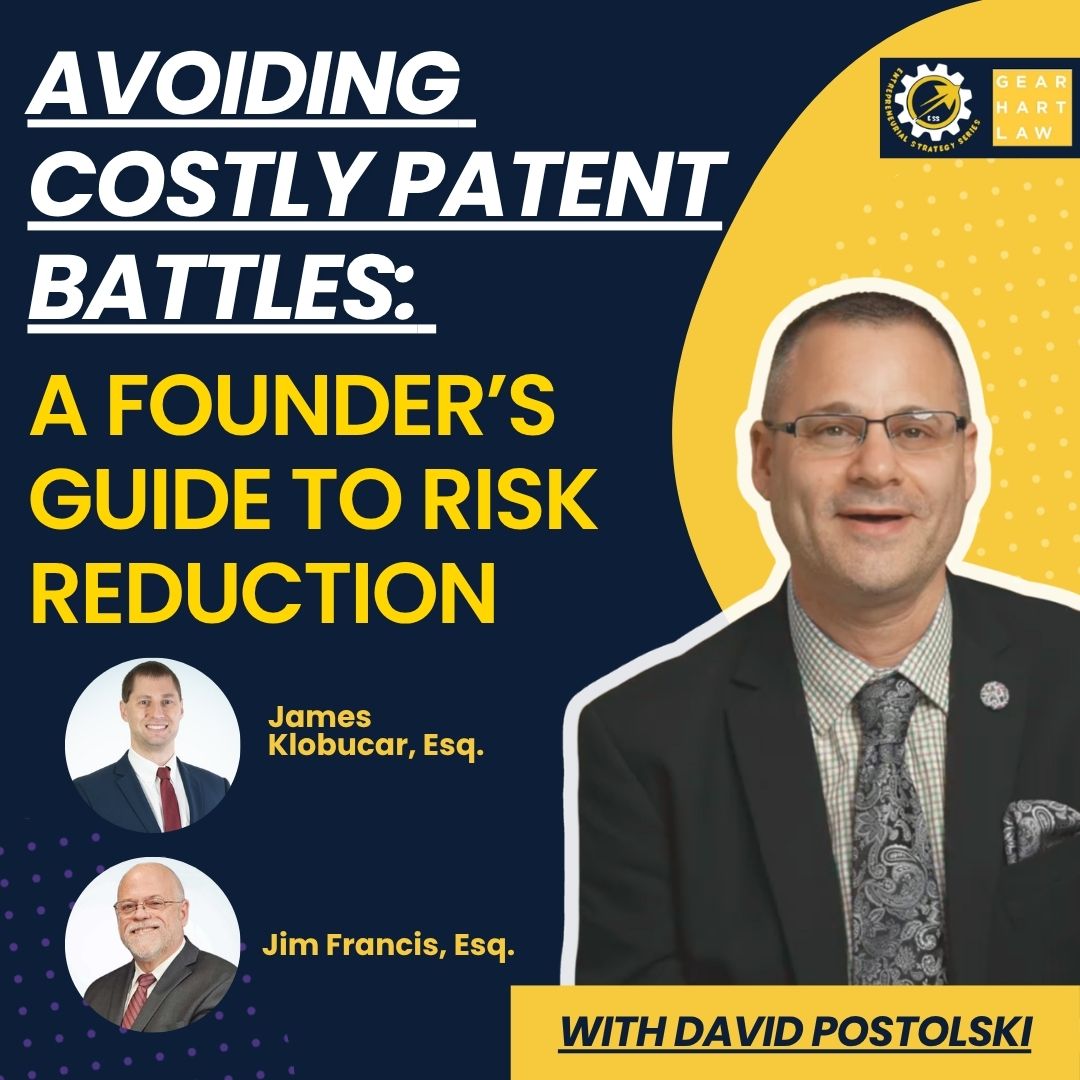
My name is Dave Pasoski. I'm an IP and patent attorney, a partner at Gerhardt Law, which is one of the, one of the sponsors of this, of these sessions.
We are recording this as you can see, and so the videos of all past ESS's can be found on our YouTube channel. Just search YouTube entrepreneurial strategy series. And it also is an audio downloadable podcast on like 23 outlets.
And so we're super excited for this topic.
We've been wanting to do something about patents and protection and specifically how to protect yourself from, from, from everything related to litigation and infringement and, and even how to bring those suits yourself. And so we have two partners, my fellow partners at, from Gerhart Law, who have been doing this a long time and we're super excited for you to meet them. So I'm going to ask them to introduce themselves and then we' to an informal conversation. So first I'm going to ask James Clover.
James, I'm gonna hit it. Hi, James, good to see you.
[00:01:47] Speaker B: Hey, David. I'm good, how are you?
[00:01:49] Speaker A: Good, good, good, thanks.
[00:01:50] Speaker B: Good, Yep. So my name is James Clover. As David said, I am a partner here at Gearhart Law. I've been with the firm since 2013.
I've been a partner since around 2021, give or take, and my background's in biochemistry, molecular biology. Handle all facets of intellectual property law.
Anything that can help startups and entrepreneurs be successful in terms of litigation and particularly patent litigation, as we're going to talk today.
Represent plaintiffs, defendants big and small, you know, getting the best result, you know, possible. However that. However we can do that.
[00:02:34] Speaker A: Awesome. Thank you, James. Let's just find Jim. Jim, who are you and where are you?
[00:02:41] Speaker C: David, my name is Jim Francis. I'm a newer partner at Gearhart.
I've been there since May of 25, got about 23, 24 years on IP litigation experience.
We've done patent and trademark litigation across the country, including for clients as big as Walmart. And clients as small as individuals.
So hopefully I bring a little bit of experience to the table. I think the gray hair kind of gives that away just a little bit. But I am a patent attorney.
Our background is chemistry, particularly petrochemical. I used to work for an oil company and also have a background in process engineering and some information technology.
[00:03:35] Speaker A: Awesome. Yeah, we're super excited to have you, Jim, let's go. Let's start with you. Since you're, since you're on Spotlight, maybe you can talk a little bit about some of the. Because there's some. Just from some of the comments that you might have heard in the networking session, maybe you can talk about some of the kind of best practices is that it actually doesn't matter to me whether you're an independent inventor or a large company or a small company. What are some of the things that you can. That you should be first be doing in terms of protection?
[00:04:06] Speaker C: Yeah. Whether you're a small inventor or a large company, you always have the same general issues, which is, you know, first and foremost, identifying what you have.
If you don't understand what intellectual property you have, if you don't have an IP inventory, it's going to be very difficult for you to take the approach of defending it against anybody or even protecting yourself against allegations.
So getting a good understanding of what you have is important. And one thing I heard earlier that I liked a lot, and it's kind of, kind of dovetails with kind of a saying I have, I give to everybody and that's nobody steals a bad idea. Now, that's not necessarily true, but the fact that you're being infringed isn't necessarily a black mark. It's a problem that can be addressed, but it shows somebody seeing some value in what you're doing.
Of course, there's cost associated with that and there's ways to mitigate costs. There's ways to mitigate infringement.
It's a very complex area, but little things like obtaining intellectual property coverage insurance.
Like there's a. An intellectual property insurance services company of the Fluval, Kentucky, and I've litigated cases under their policies. And it made the difference between little companies staying in business or big companies just winning because they outspent the other side. But identifying what you have, making sure that anyone that's participated in the project has signed over whatever patent rights they may have, being very, very careful with suppliers and vendors.
Most of the patent litigation I get involved in is because somebody along the product development road saw the value and decided to file on somebody else's patent.
And that can be very difficult, very expensive, but it's easily avoided by just having the right agreements in place and having everybody on the same page as far as what everybody's rights and responsibilities are. And that's critical.
[00:06:36] Speaker A: Yeah, excellent points, I think. Yeah. By the way, it was me that said, yeah, it's a good problem to have.
[00:06:41] Speaker B: Right.
[00:06:41] Speaker A: Infringement is a good problem to have because it means that you, that you have something worth copying. James, kind of same question to you. What do you think some kind of best practices early on that you've seen that people should or shouldn't be doing?
[00:06:55] Speaker B: Yeah, I'll echo Jim's sentiment. And you know, the phrase I use often is getting knocked off is the hallmark of a good idea.
Because, you know, as Jim say, you know, not, not always true, but, you know, if you have, if you have something, you know, and people want it, you know that that's what ends up happening, whether it's, you know, someone on Amazon or Etsy or it's a more sophisticated entity elsewhere. You know, having, having that idea is, is something that, you know, is attractive to people.
So, you know, it shouldn't be all doom and gloom, but the, but the mindset should be, well, well, now what do we do about it? We have the ip, hopefully secured by that point. And so since we secured, we have, we have, we have something to enforce. Right. At that point, if you don't have that, you still may have a cause of action, but it's probably not going to be for patent law. Right. Or a patent infringement. It's going to be maybe a potential other theory depending on if they violated a contract with you, as Jim alluded to, you know, down the supply line and what have you.
So that's, you know, definitely something to keep in, keep in mind in terms of just how you approach the matters.
Because I do think having, having the correct mindset and understanding what's in front of you does help make things, you know, more palatable and, and, and understandable for you. If you, you're walking into a litigation with a, with a doom and gloom mindset and, you know, woe is me, I think that's, that's putting you off on the wrong, wrong foot to start.
And that's not going to bode well, you know, for the future.
You know, outside of that, you know, Jim mentioned, you know, the insurance, you know, also litigation funding, you know, from third parties is a good option as well. That can fill a gap there.
If insurance, you know, for one reason or Another, isn't, isn't an option or isn't something that you have at that point. And I'd also encourage, you know, individuals out there, you don't necessarily need litigation funding or have any, any deal lined up, you know, prior, but you should investigate those entities. You should understand who they are, what they do, and generally how they could interact, you know, with your company. Because it, you know, what, when, when it hits the proverbial fan, you know, again, it's good to be prepared.
[00:09:16] Speaker C: Right?
[00:09:17] Speaker B: It's good to have, you know, some idea of who, who you need to contact or what you need to do in order to move it forward in a effective and a timely manner.
Because there are, there are deadlines and there are, you know, things that need to be done in such a way that you don't find yourself, you know, behind the eight ball trying to play catch up, you know, rather than offense, you know, particularly if you're on the enforcement side of things. Right. You don't want to constantly be, you know, reacting. You want to be proactive in terms of how you approach, you know, your IP and enforcing the ip.
[00:09:54] Speaker A: Yeah, that's actually a good point. Maybe we can split that up, actually. Maybe we can talk about creating a strategy to go against others, enforcement, as you say.
So let's, we can talk about that now for, for a little bit, and then we can get to the point of, like, somebody's accusing me of infringement, and we can talk about how to kind of defend against that. But what are some of the things we can. But what are some of the things that you personally do to ensure, at least for your clients, that they are at the strongest maximum, you know, a status to potentially go against somebody with their patents? Is that something you can comment on?
[00:10:36] Speaker B: Yeah. You mean you're talking enforcement, right?
[00:10:39] Speaker A: Yeah, I'm talking enforcement now. Yeah.
[00:10:40] Speaker B: Yeah.
It really starts, you know, at the very beginning. Right. Did, did you do a patent search? You know, was it a good quality patent search? And then how did that, you know, turn into drafting the application, you know, the enforcement opportunity and these strategies that are going to be available to you are going to be as, as good as the patent that you have. If the patent has, you know, issues or if you've missed some prior art that can lead to the patent being challenged and potentially invalidated, that's not good.
[00:11:14] Speaker C: Right.
[00:11:15] Speaker B: And what's the de facto response, you know, in most cases, if you say to a third party, hey, you're, you're infringing my patent, it's not usually oh, gee, you caught me. It's. Well, no, I'm not, because your patent's invalid.
Right. And so, you know, and, and, and oftentimes they may file a counterclaim against you regarding the validity of the patent, or they may institute, you know, a proceeding before the USPTO to try to challenge the patent there.
So, you know, securing the IP and having someone on your side, you know, from the start, to put, to put everything and line it up in a row first, again starting from the search into the application.
And that way you're going to have a strong patent in the end. And one thing I'll add is I often tell clients, think not only of what your invention is and what it could be, but put yourselves in the shoes of a third party who's going to be looking at your patent. They're going to say, gee, John has a great idea here.
We don't want to step on his toes with the patent. What can we do to get around it? Because we can put those types of things into the application as well, and that can help shore up your patent for multiple facets.
[00:12:31] Speaker A: Yeah, I love that. Excellent, excellent points. Jim, anything to add? Probably a lot to add. What do you think?
[00:12:37] Speaker C: Yeah. Following on what James said, how the patent is written is absolutely critical to enforcement.
It has to be written with the mindset of what will it take to defeat the patent, to invalidate the patent?
And that's where a little patent litigation experience comes in handy, is if you've ever been on the other side where you've had to invalidate patents, you understand what those weaknesses really are and how to kind of shore up the patent.
But I think something that's critical, especially at the enforcement level, is the IP owner has to truly understand the patent. They have to understand the purpose, they have to understand what it covers.
They have to have some kind of a business plan, some objective for using that patent. I had one client who was a large international printer company, and they would routinely monitor the competitor to see where are they going.
And they would even file what we call blocking patents or jepsen patents on improvements to block that next step that that printer company was going to make.
So the same thing can be reversed. It can be used against you as well. So you need to anticipate where things are going. You need to try to get as broad a coverage as possible and consider, you know, future developments and just don't leave them laying on the factory floor. If it's not protected, if it's not even disclosed very much, it's Certainly possible somebody can, else can come in and try to capture your own IP and use it against you. So, but things come into play like as far as enforcement, understanding what your market is, and when I've dealt with clients in the automotive industry, we would necessarily look at not just where cars were being manufactured, but what were the major distribution points, where were the parts coming from.
All that plays into having and enforcement landscape that you can work with.
[00:15:03] Speaker A: Yeah, you know, Jim, I want to, I want to, again, still sticking on enforcement because we often hear this a lot where people will get a single patent and, you know, base their entire enforcement strategy on that one single patent. They're also basing their entire licensing, you know, the holy grail, if you will, their whole, their whole licensing play on that one single patent. I think you and James kind of, kind of both said it, but like, is that, you know, a particularly good strategy per se?
[00:15:42] Speaker C: It's risky because you've only got one wall between you and the outside world.
Having a patent portfolio that covers different aspects, different features, breaking it down into all the novel aspects gives you broader coverage. And it's much more difficult to go after 2, 3, 4 patents than it is one patent. If one patent falls, what are you left with? You're left with nothing or maybe a dramatically reduced patent scope.
So you have to be able to envision what it is you need to cover, what the possibilities are down the road if competitors coming after some of these patents and identifying what features, what novelty is most important and most valuable and kind of add some extra safeguards in around that.
[00:16:38] Speaker A: Yeah, excellent points, James. Anything.
[00:16:41] Speaker B: Yeah, yeah, absolutely. And I'd add, you know, too, when Jim's talking about a portfolio, it doesn't necessarily mean you have to have a ton of ideas, right? You, you can have your singular invention, but you can build a portfolio around it. And without trying to get, you know, too technical on, on patents, you know, one of the options, you know, is to have a continuation application that, that's filed.
The, the advantages to that is that it, it leaves essentially your patent portfolio, we'll call it open, if you will.
It gives you opportunities to revise the claims to some degree. Particularly if, let's say you find a third party who you believe is infringing, you look at the pat. The claims that have already issued in your patents and you say, well, oh, gee, you know, I have something here that they don't have. Well, you can tweak those claims in a pending continuation to try to explicitly cover that third party to give you additional ammunition to go after them. And by virtue of these additional continuation filings, you can, as Jim said, create a rather robust portfolio. That doesn't necessarily mean that you have multiple inventions per se, but it can still stem from a singular, singular idea or invention that maybe has improvements or modifications. Or you're simply taking and adopting a strategy to go after differing subject matter, perhaps broader subject matter in a continuation that can be used to your advantage in potential enforcement.
[00:18:16] Speaker A: Yeah, I love that, James, considering that the United States is really the only country in the world that has continuation practice that allows you to kind of, you know, be your own and be your own improver, if you will, or be your own tweaker, to use your words. I think that's a great strategy.
Okay, so you recognize. So, so, okay, so you build out this portfolio of continuations, other inventions, and then you, you know, some of those patents may be granted, maybe some of them are not.
Like, we, we, we, we often get this question a lot. I think it's an important one.
You now have discovered that somebody's potentially infringing you.
What, like what are the next steps there? So I come to you and I say, hey, you know, I have a bunch of patents. Some of them are granted, some of them are pending. Again, the answer may change there, but like, I think that there's a third party that's potentially infringing me.
What can we do now? What's the next step?
[00:19:23] Speaker B: I guess the next step is to really do your due diligence.
You know, that's, that's step one, you know, and when clients say, well, hey, I, I found someone who I think's infringing the patent, I say, okay, well, well, send me over the information and let's sit down and take a look. Because again, the, the claims of the patent application or excuse. Well, the patent or patent application, you know, that that's really the key, right? Even if they sound similar, if the claims are vastly different from the alleged infringing product, you may not have a cause of action.
And so typically we're going to go through an exercise that's going to allow us to do some in depth review and investigation of the alleged third party product.
We're going to probably draft, you know, internally at least a claim chart to compare claim elements to the alleged infringing device.
You know, we want to make sure that we're making a colorable, you know, you know, claim at that point in terms of, you know, what we have and what we're going to do to move forward. Because you Know, if you, you know, don't have a claim and you kind of put your foot in it, it can really backfire on you in a way that could negatively impact, you know, your portfolio and find yourself, you know, in, instead of a position of power, again, on the defensive, which is not necessarily the position that you wanted to be in when you said, hey, I found someone who I think is infringing. And then you find yourself having to backpedal and, and say, and do a mea culpa.
So I think those are really important first steps, you know, before you get into the cease and desist letter, which, assuming the facts and circumstances support it, is probably going to be your next step. At that point. It would be, you know, exceedingly rare, in my opinion, that anyone would just move to file a lawsuit. There may be circumstances as to why you file a lawsuit immediately, but most, most often, you are going to send, you know, a cease and desist letter to provide the other party with notice of your patent rights and to attempt to resolve the matter without proceeding forward, you know, to litigation first.
[00:21:32] Speaker A: Yeah, excellent, excellent. Jim, anything to add?
[00:21:35] Speaker C: Yeah, also along those lines, I think it, again, it's critical to understand your own patent scope. You don't want to make inappropriate allegations. You don't want to make presumptive allegations of infringement. Those can come back to haunt you.
I think that the more you can support the concept that, hey, I think you've crossed the line with a claims chart, with a reasonable analysis. Yeah, it's critical.
And I think keeping that in mind, when you do reach out to the other side, it has to be done carefully. You can't just immediately send a scathing letter. It's got to be reasonable. It has to identify the product, it has to identify the feature, it has to map that back to a patent claim.
And you have to keep in mind that your cease and desist letter will be an exhibit early on in the patent litigation, if you get to that point. So you want to come across to a jury and the court that you've done everything in your power to resolve this prior to litigation.
And that means when you do send a cease and desist letter, you have to give them an off ramp.
You have to say, you know, given that this may be an accident, given that this may not be intentional, we think this can be resolved prior to litigation.
Here's what we propose.
And that's important also because you don't want to give them ammunition to run to court and file what's called a declaratory judgment. Action, which is asking the court to intervene and go ahead and assess what those patent rights are.
Unless there's an immediate risk and threat of litigation, a declaratory judgment action typically is going to be difficult to raise and maintain in a patent case.
[00:23:36] Speaker A: Yeah, all excellent points. Yeah.
[00:23:39] Speaker B: And David, I just, I think I'd add really quick on Dave or on Jim's point with the declaratory judgment action, and where that can really prove problematic for you is let's say that the other party who you're, you know, reaching out to is in a disparate jurisdiction from yourself. Well, odds are they're going to file that declaratory judgment action in their home jurisdiction. And now all of a sudden, instead of trying to enforce something, you find yourself on the wrong end of something halfway across the country.
And obviously that provides then its own challenges for you as well.
[00:24:16] Speaker A: Yes, all good points. What are your, I'm curious what both of your thoughts are on sending such letters.
I mean, sending a demand or a cease and desist letter, but, but it being sent by the patent owner and not by a law firm. Any, any particular. Because. Because we see that sometimes, right. A client will come in, you know, and be like, okay, you know, now I need your help. I tried to, you know, do this on my own. No one responded to me or told me to kick rocks or whatever the situation is. What are your, what are your thoughts here? We'll start with James.
[00:24:58] Speaker B: Yeah, it's a good question. My preference is to always have a letter like that, you know, reviewed by legal counsel before it goes out. As I, you know, Jim is said, and as I've said previously, doing it incorrectly can be quite detrimental to your cause.
You know, that being said, there can be circumstances where, you know, with our blessing, our review, or whichever legal counsel you have, it may make sense for the patent owner to send an initial correspondence. You know, people get weird when lawyers get involved. Right.
Sometimes it's easier for a business person to say, hey, business is business.
You may not know about this. I think you're kind of, you know, stepping on our toes. Let's talk about how we can resolve it.
Now, like I say, doing that with legal counsel's blessing, to be able to say, here's our strategy, you know, go over the communication that's going to be sent out and when they do respond, you know, don't respond directly to them. Let's talk about it and let's see, you know, what the path forward is going to be at that point.
You know, in those circumstances, you know, we can work it out, I think, in those. But otherwise, you know, I'm skittish about when people are sending their own stuff or when they come to us as a potential new client. They say, well, hey, I've already sent this letter out, you know, can you help me now? They didn't respond, or they told me to take a hike or whatever it was.
And sometimes the answer is, you know, we don't want to get involved because of what's transpired previously.
And if that's the case for us, that may be the case for other firms, too. And if you find yourself, you know, in that situation where people don't want to touch it for whatever reason, you know, obviously, then that's going to be difficult for you under your enforcement.
[00:26:51] Speaker A: Yes, excellent points, Jim.
[00:26:55] Speaker C: Yeah, I think, you know, James, hit on something important there, and that's at least have your patent attorney review it before you send it out, because you may make certain admissions or statements that come back to haunt you.
You may actually waive your rights to certain causes of action or positions based on mistaken assumptions or just choosing the wrong language. And I'm a big fan of trying to work things out between businesses before the letters start flying between attorneys, because the minute somebody gets a letter from an attorney, things ratchet up, walls go up, everybody gets defensive.
And I think it looks better to a court and to a jury if they try to work it out in an informal process first.
But again, that being said, what you have in that letter is critical.
So if it's not reviewed by an attorney, you don't know what kind of damage you've caused until an attorney does look at it. And that may mean that a law firm will not take your case because there's nothing they can do.
[00:28:14] Speaker A: Yeah, that's right. I'm going to keep the spotlight on both of you. There are some questions in, in the chat that are, that are particularly on point that I just that I'm not going to save to the end.
Richard, what just wants a 90 seconds on what is a patent? Richard, that's a big, that's a big second. That's a big question for just 90 seconds, considering there are two types of patents. There are design patents and utility patents. But I don't know. Jim, you want to give a 90 second on what a utility patent is? James, maybe you can do a 90 second on what a design patent is.
[00:28:49] Speaker C: Yeah, utility patent covers what something does. It's utility. It covers how it works. It can cover methods, can cover formulations.
But the important Thing is, they're typically, you know, except for method patents, physical features you're trying to capture in the claims.
One thing I think that gets lost on a lot of people is that a patent, regardless of what kind of patent it is, is a business tool. That's it. It can identify scope, it can identify the boundary of your legal protection, but it is not the end all and be all. There's a lot that goes on behind the scenes.
So, you know, the utility patent will cover, you know, again, the fundamentals, the basics of devices, methods, you know, what you traditionally think that a patent is.
[00:29:47] Speaker A: Yeah, often I say, Richard, it's something that's based in science, chemistry, physics, biomechanics, electrics, computer science, geology, botany, something like that. There should be some science hook, if you will, in order to have a utility patent. James, Design patents also pretty important. 90 seconds.
[00:30:05] Speaker B: They are design patents are different from utility patents. Design patents only protect the ornamental appearance of an item. We're not talking about the function of an item. We're not talking necessarily about the interrelationship of parts. We're talking about how does it look. Right. And how it looks, I mean, does drive a lot of consumer purchase decisions nowadays. You think about are you an Apple person, are you a Samsung person or a Google person when it comes to your phone, right. There are a plethora of design patents that cover various design elements and features, you know, of those phones.
And so, you know, that's, that's really what a design patent is going to protect. You know, design patents are different in a number of aspects. The patent term is different from that of a utility patent. It's 15 years from the date of issuance prior, as opposed to 20 years from the date of filing.
Design patents are not heavily text based. They're mostly made up in the drawings. And so you have to have someone that knows really well what they're doing when it comes to putting those drawings together.
And they can generally be more, less expensive, you know, to obtain and then maintain in some instances. And the scope of protection may be narrower though. And so that's something to think about. How can we best, you know, broaden that scope or how do we file multiple design patents to kind of increase that coverage a bit? You know, you think of each patent a little bit as a circle in a Venn diagram, you know, as opposed to just one. You can have multiple overlapping circles, which gives you the net effect of an increased, you know, patent coverage.
So hopefully that, that explains, I think, design patents pretty well.
[00:31:47] Speaker A: Yeah, that's that's great. Aziz put a comment, but it is incorrect. He wrote, don't forget the duration. Design patents last 15 years. Years. That's correct. Disease. While utility patents last 25 years.
That is incorrect. And so it's actually 20 years from when you file. So just keep, keep that in mind. You may want to kind of edit your comment.
Let's talk about this. A few questions on searching. I mean, searching is a really important part to this. People will come into our, into the office with all sorts of ideas and truly maybe took us a few seconds to realize that, hey, your idea is already out there. It's been published in a publication. It's on the App Store or whatever the situation is.
It's already in a patent somewhere. So I wanted to, if we can just talk a little bit about searching using Google, using the uspto, what are some kind of tips that some of the folks that are listening or watching this recording that you can kind of give on searching? We'll start with Jim.
[00:32:53] Speaker C: Yeah, searching is critical for a number of reasons.
A lot of companies, a lot of inventors use it at the outset, kind of as a research clearance. Okay, what's the fertile ground ahead? What hasn't been covered? What hasn't been explored?
Do you necessarily want to go down the path everybody else went down because you're going to get narrow coverage, or do you want to try something different?
And there's additional types of searches, there's freedom to operate. If you have a pretty good idea what the commercial embodiment of your product is going to be your invention, then you can more precisely search on patent claims and determine, you know, what's the risk to the commercialization of the project. Whose toes are you going to step on?
Of course, patentability is what everybody thinks of when they hear patent searching is what I have patentable.
And, you know, like David said early on, getting the patent isn't necessarily the hardest part of things.
It's keeping the patent or enforcing the patent. And while things may be patentable, the scope may not be broad enough necessarily to justify the expense.
Again, you have to look at it like a business tool as well.
There's different search criteria depending on what you're trying to do, even landscape searches.
I have companies that contact me and want to know, okay, we're getting into this area. Who are the big players?
What kind of technologies are covered?
What do I have to worry about?
And to some extent, even, you know, which of these competitors is going to be litigious, who's going to file Lawsuits and are they going to be reasonable? Are they going to be rational? That are they just, just going to be trying to chase me out of business?
So there's a number of different reasons to do searches and you know, the end result really kind of drives what goes into it. You know, Google patents is decent, not a huge fan, but it's easier to use than the uspto.
There are some other free things online. Well, actually free patentsonline.com I know a lot of people use and has some pretty good robust features and there's no cost.
You know, attorneys tend to use commercial products.
We dive into things like invention classification, those kind of things. We look for specific patent claim language that your average, you know, pro se or your inventor wouldn't necessarily go down those roads.
But it's still a good idea for you as the inventor to do a little searching on your own and see what's kind of laying ahead of you.
[00:35:54] Speaker A: Yeah, excellent points. James, anything to add?
[00:35:58] Speaker B: Yeah, I think, you know, you can definitely use all the tools. You know, Jim pointed out, you know, some may be more desirable than others. You know, when it comes to Google or other tools, you know, Big Brother's watching, you know, keep that in mind to some extent. Right. In terms of what, what you're typing in, what you're uploading, what you're searching, what activities you're doing.
But I think another big aspect of searching is keep in mind in terms of what tool you're using, you know, what it includes and what it doesn't include. You know, for example, the USPTO includes USPTO patents and patent applications. Doesn't include anything from Europe or it doesn't include anything from Canada. And patents are jurisdiction specific. So you may say, well wait a minute, if it's jurisdiction specific, it may not matter.
However, while you may have a patent in the US that patent is only valid in the US it's not valid in Canada. And if you want to get a patent in Canada, you have to file a patent application there. However, it is valid for a US patent examiner to cite a Canadian patent or a Canadian patent application against you and reject your US application.
So just jumping onto a site or a free site and saying, oh well, I did some searching, I'm free and clear.
Maybe you are, maybe you aren't. And keep in mind of what the database has in it and what it doesn't have because prior art, you know, which is your patent, third party patents, patent applications and non patent literature, you know, that's worldwide from, from the dawn of time.
And it's all fair game for a U.S. examiner to use to reject your U.S. patent application.
[00:37:37] Speaker A: Yes. Great, great. Let me, I'm going to go switch, switch gears a little bit to Jim.
Let's talk about the flip side of that if we can. So now you're being accused of infringement.
Maybe you have your own patents or maybe you have a product that you're selling.
Maybe you can talk about it from that angle a bit as well.
[00:38:01] Speaker C: I think the most important thing to keep in mind is if somebody's alleging you're infringing. If you get a cease and desist letter, take it seriously.
If you don't take it seriously and something happens down the road, it would be very easy for a court or a jury to look at this as evidence of willful infringement.
So you want to avoid that if at all possible. And you also want to try to, you know, keep your communications back with the person making the allegations somewhat vague. You don't want to make admissions.
This is for why you really need to have an attorney involved in this.
And to some extent they can be phrased in terms of, say, a settlement negotiation so that parts, if not all of it, can be excluded as evidence at trial if it gets to that point.
But as far as the allegations, you have to go in and again, you have to determine what's the risk, what's the likelihood you're infringing.
They may or may not provide you with a claims chart.
Even if they do, it's a good idea for you to have a good understanding, especially with your patent attorney, where your product actually does or does not fall within the scope of their allegations.
And there's, you know, more technical issues as well.
It could be the person making the allegation doesn't have the right to enforce the patent.
I've seen that happen before where somebody had a non exclusive license and did not have a license to enforce the patent, file patent litigation. And you can't do that.
But the average person, someone who's not a patent attorney, not a patent litigator, wouldn't understand that and wouldn't understand that was an easy chance for a motion to dismiss a lawsuit.
So you got to keep the risk in mind. And that's what you know, really attorneys are. We're risk managers.
Our goal is to keep you from getting sued. Our goal is to keep, you, if you are sued, keep you from having to go to trial because you never know how that's going to turn out.
It's to come up with the best resolution as a business decision.
So you have to take the emotions out of it. You have to take the ego out of it.
A lot of people take this stuff personally, and you can't.
At the end of the day, it's, what's it going to cost?
And if it's. If it's a product that doesn't make very much, if it has a limited market, it's easier just to say, I'm not going to spend 2, 3, 4, 5, $600,000 in patent litigation for a product that generated $15,000 last year.
Those are easy decisions to make, but sometimes egos do get involved.
[00:41:09] Speaker A: Yes, 100%. If we can just take out the egos from these situations, they probably would settle way before it ever gets to court. James, you probably know a little bit about that.
[00:41:21] Speaker B: Yeah, of course, as Jim said, risk managers and risk assessment is. Is the name of the game at that point.
Right.
Do. Have they. Have they put forth a colorable claim of infringement? You know, yes or no. Are there technical aspects that we can use to combat any potential claim? You know, we want to do other things as well. We want to look at, you know, who is the entity that's sending the alleged, you know, cease and desist letter here making the allegations. Is it a sophisticated entity? Are they not. Are they represented by counsel?
If they're not represented by counsel, you know, are they just, you know, some guy off the street? Have they filed a bunch of other lawsuits against everyone, or do they know what they're doing to some extent? If they do have counsel, what counsel do they have? How much can we anticipate that they've paid counsel to write this letter? I mean, there may be people out there who will say, yeah, we'll write you a cease and desist letter. It'll be 500 bucks. There may be another firm out there who says, well, we're going to do, you know, the background review and investigation. We're going to put together a claim chart. We're going to do this, and we're going to charge you $5,000 for it. Right. You know, it. All of that goes to, you know, the pockets of the person who's. Who's writing the letter and how serious are they. Right. And those are parts of the risk management, you know, assessment that we. We have to make and try to decide, you know, not only how colorable of their claim is their claim, but how aggressive are they going to be and how problematic are they going to be, and what do we need to make? What do we need to do? To make this go away, as Jim said, before you get sued or before you go to trial. Because at the end of the day, you know, startups, entrepreneurs, you need to be putting capital, you know, into your business. You don't need to be fighting lawsuits. When you're trying to, to bring a product to market or you're trying to scale up, it's just a complete waste. And it has the very real opportunity to essentially tank your business. Right. Right then and there.
And so, you know, at the end of the day, it is a business decision. You say, well, wait a minute, I'd rather pay. And I hear this all the time, I'd rather pay. You referring to me, the attorney. I'd rather pay you to fight it than to pay them a dime.
It's great, I love to hear it. But at the end of the day, pay them, make them go away. Right, because you can get on with your life then and you don't have to worry about, you know, the stress. The stress, you know, everything else that comes along with it, you know, and so that's, that's, you know, how I, how I approach it, you know, from the, from the beginning.
[00:43:50] Speaker A: Yeah, I love that. Let's talk about. We've been dancing around it a little bit, and I think there was one or two questions in the chat.
Funding like this. I, I mean, we represent startups, we also represent multinationals. Nobody has money, right? That's just what it comes down to, right? Nobody wants to spend money on this, but this stuff can get kind of expensive. You know, even the patent application get expensive.
So what are some things that, that, that maybe you can talk about just about the overall cost and money that kind of, that kind of needs to happen here. I will say, I will premise this on, on we'll say one thing I often say to people, again, getting the pad is not only the easiest part, it's probably the cheapest part of your journey, right? Manufacturing, prototyping, I mean, marketing or SEO or Google, that shit's expensive.
And so if you, if you can't work out the finances at that early stage in order to get the IP protection you need in order to go against somebody potentially in the future, then I'm not so sure this is the right path for you. But, I mean, yes, that's a very harsh statement, but I don't know, James, maybe you can break some of that down.
[00:45:06] Speaker B: Yeah, I mean, I think it goes to what we already mentioned. You know, insurance, you know, is a good opportunity. You know, litigation funders can be a Good opportunity as well. Keep in mind, a litigation funder, they're going to want a chunk of it. They're ponying up, you know, the bucks for you. They, they want something on the back end. And it's, and it's not going to be small either.
You also have to account, you know, in those instances in terms of, you know, lawyers fees, or is someone doing it on a contingency? Are you paying them straight? How is that going to interplay with any funding, you know, agreement that you have out there?
And, you know, it is, as David said, it's a very, very expensive process. It's one of the reasons that, you know, most people, you know, never face a lawsuit and that if you do face a lawsuit, you don't end up going to trial.
There's too much, there's too much risk, there's too much at stake.
And most people don't have the financial wherewithal to be able to go through it.
You know, the amount of people who will, you know, call us up and say, well, someone ripped me off and I want to sue them. And let's say hypothetically, I can give them a number to say we need to do X, Y and Z, and it's going to cost 15,000 to do that. And they say, oh, are you sure?
And it's like, well, listen, yes, you know, I, I didn't just pull, pull the number out of thin air.
But two, you know, if that, if that's going to be a problem, you really have to evaluate what are you doing with the product too. Because, I mean, there's so much, as David said from the very beginning, there's much that goes into bringing a product to, you know, getting the patent, bringing it to market. You know, every, you know, tooling molds, whatever it is, everything that goes into it.
You know, you can't, you can't balk at, you know, at dollar amounts like that. At the end of the day, I mean, you have to be prepared to either, you know, go into it or you have to find an alternative strategy to resolution.
[00:46:58] Speaker A: Well said. Definitely. Jim, thoughts
[00:47:03] Speaker C: if fundraising has for litigations been proving to be easier and easier over the years.
I've even been involved in some litigation where there are patent litigation, boutique firms that go out and they find clients or they're sought by clients. And it literally is a contingency situation, but it's got to be a really good situation for the patent holder for a patent firm to invest that kind of time and money, because just getting experts on board typically will cost at least $60,000, sometimes a few hundred thousand dollars. So before they're going to take the risk of backing themselves in a corner where they have to write big checks, they are going to take a, a substantial amount. They're going to make sure the patent is worth enforcing, but they're also going to make sure that the person or company they're enforcing it against has some assets.
You know, that being said, I was recently involved in a case where the attorney was from a small firm and took the case just on the possibility that the court would award attorney's fees.
So we went through a lot of litigation, a lot of time and a lot of money just so somebody could try to make some money off the attorney's fees. That's really what it came down to because there weren't any damages.
So it's easy to get sued. Judges typically like to get these things dismissed.
But, yeah, there are ways to enforce these things. I've actually litigated under intellectual property insurance policies.
We had one case 23 years ago that involved Tyco of all companies, but just a behemoth back then, one of the biggest companies in the world going after small companies in the retail tag segment. You know, the antennas beside doors, or if you, you don't get the tag off, the clothing, the alarms go off.
They spent a fortune doing that. And if it hadn't been for the intellectual property insurance, the clock would have went out of business.
Now, even 23 years ago, they had to pay, I think, a monthly coinsurance amount of $25,000. But that was based on the policy they took. There are all kinds of different coinsurance rates, all kinds of different levels of risk.
And typically there is going to be an IP insurance policy that is suitable based on the product and the market.
But again, if your product's not making any money, why would you spend the money on an insurance policy? Why would you not just walk away from it rather than spend hundreds of thousands of dollars?
It really is a business decision.
[00:50:15] Speaker A: Yeah, I think that is definitely the, that, that, that, that is the through line for today's session. I do want to just comment. Aziz, I saw your comment after James said what he said. He said. He said, ouch. That's pretty discouraging statement for inventors like me, but I get it. Are there companies you can collaborate with or how do you typically manage a given cost? I'll just say this and thank you, Tammy. We are. I mean, there are small firms that are out there that just get it. We understand the cash flow issue. We understand the crunch, we understand that you may not have money or we understand that, that, that that money comes in in the form of, of investors later on, whatever the situation might be. We've heard it all. But you got to work with a firm that kind of puts their money where their mouth is and is willing to kind of work with you, especially if you have something novel, especially if you were the first to file. That's why I said it before. I, we, we've seen it, we see it every day. Justice prevails for the small inventor, for, for many of our clients. And so if I didn't believe that, I probably wouldn't be doing this.
So, yeah, get in touch if you want more information, information about that.
[00:51:27] Speaker B: David. I'd add more.
I mean, certainly there's alternative strategies to just diving into litigation.
[00:51:33] Speaker A: Right, right.
[00:51:34] Speaker B: I mean third, third party platforms, you know, we deal a lot with Etsy and Amazon and, and ebay and other places where there may be infringing products. And there's mechanisms by which you can lodge IP complaints or go through much less costly mechanisms, you know, available through those platforms to resolve disputes, delist products and things of that nature.
Certainly if litigation, you know, and litigation isn't going to be typically the recommended course of action. Right.
As Jim says, the damages have to be there. There has to be, you know, a lot of pieces that align for that. But there's a number of alternative strategies that can be used to enforce the patent again without having to dive headfirst into litigation. And we've been successful in doing that. Whether again, it's delisting Amazon products or whatever it may be.
Those are still powerful tools at the end of the day.
[00:52:31] Speaker A: Yes.
[00:52:34] Speaker C: Some strategies could involve cross licensing.
You can cross license to the other company's competitor if they have a beef with them, if they see the value in it and want to enforce it, you can keep the patent, you can exclusively license it, and then they have the right to enforce the patent.
[00:52:57] Speaker A: Yes, that's right. Just a few more minutes left. If you have questions, do, do chat them. There is one up here that I thought was really interesting from Tracy. Hi Tracy, good to see you. See, good to see your name out there.
I don't know if you saw it. Jim and James. She says, she says, are there, are there meaningful differences in how you approach infringement analysis or litigation strategy between software patents and patents covering physical products?
And does SAS complicate that further? What do you think? Yeah, it's also kind of a loaded question that can probably be a whole Session on But some some initial thoughts, Jim?
[00:53:38] Speaker C: Yeah, software patents.
Yeah, there's been a lot more activity in the past few years.
One that I was involved in that resolved last year was between printer companies and an inventor with some software that would allow different printer brands and formats and technologies to all communicate via this piece of third party software. So the fundamentals are still there. You have to have the claim scope, you have to be able to demonstrate that more likely than not they're infringing.
You know, the big difference comes into calculating damages and what kind of experts are involved. So you know, software is more readily reproducible and distributable than a physical product.
So potentially the damage models on that can be very, very lucrative. And that's why a lot of third party players get involved to enforce these things or take on the rights of the patent owner and enforcing themselves because the distribution, the ease of copying makes it very easy to demonstrate to a judge or a jury, hey, there's infringement where physical products, you're looking at how many were made, where are they made?
There's a whole lot of aspects to that are there, you know, non infringing uses software is a little different. I kind of like software patent enforcement better than physical project enforcement because they tend to rely more on the experts. And most of these patent infringement lawsuits get resolved at what's called the Markman hearing, where we sit down between both sides and the judge and we go through the claims and decide what the words mean, what the actual scope is.
And at that point both sides have a good understanding of what the risk is.
And very few cases make it past the Markman hearing. Once everybody can ascertain what the risk is, then business decisions get made and people are willing to settle. But even then, sophisticated companies that deal in software are more likely to be able to understand the scope of what their software is, what it does, how it's working, and are also more likely than not to make damaging admissions.
You know, we have one case where the VP of research for printer company went to a Vancouver trade show and made raving, just rave comments about somebody's new technology and patent.
Then it came back to the US and they immediately started to copy the software.
That was a fairly easy case to prove and settle pretty quickly. But again, I kind of prefer software, but you know, it depends on the project. It depends on the market really.
[00:57:19] Speaker A: James, I want to give you some final thoughts. You don't necessarily have to answer that question, but just in general, James has to jump off in about two minutes. But Is there anything you want to just say in closing?
[00:57:32] Speaker B: I mean, again, you know, I think from what we've said from the outset, you know, you have to build a good foundation on which to have, you know, something to enforce.
And that's really the key, you know, because you can shoot yourself in the foot when you go to enforce something well, before you've even contemplated there's something to enforce.
Right. And so setting that foundation is, is really going to be key.
And then, you know, as we've said all day, it comes down to risk management and assessment and, you know, we haven't touched too much on settlement and what that really looks like and the terms that typically get agreed to.
But at the end of the day, you know, what you're doing in settlement is you're agreeing amongst the parties with a result you can live with.
You go to court and even if you have a, you know, you do, you run your assessments and you say, well, we have a 75% chance of coming out ahead, that's still a 25% chance of getting bonked over by the court and spending, you know, a million and a half to get there.
And that's not a result that most people can stomach. And that's the reason most things settle. And you're not probably going to get everything in settlement that you want. You're going to have to make some concessions.
But you get a result that each party can live with and it's better than the extremes, you know, of, of, you know, dealing with whatever the court or the jury in many cases will decide.
So I think those are, you know, the things that you really want to think about and always, you know, consult with, you know, legal counsel, whether, you know, you're actually going to file a lawsuit or not. You know, as we talked before, you know, even consulting with them prior to sending out, you know, a cease and desist to someone, even if it's just between, you know, the business proprietors themselves, it all comes down to minimizing risk. It comes down to minimizing, you know, pitfalls and making sure that you put your best foot forward. Because the second you do accuse someone of doing something, you know, very few people are, are apologetic and come out and say, oh, yes, let's, how, how can we fix it? People put the wall up and they do get defensive very easily. And, you know, not having everything in place to combat that can prove difficult for you.
[00:59:52] Speaker A: Awesome. Thank you for those final thoughts. James, if you have to go jump off, please do. Jim.
[00:59:57] Speaker B: Thanks everyone.
[00:59:58] Speaker A: Thanks, James. Thank you. So much. By the way, if there were people that we didn't answer their question, just email me and we will, we promise that Jim and James will definitely send you responses. Jim, final thoughts from you or even comments on what Jim said?
[01:00:15] Speaker C: Yeah, if I could add something to what James said and something to what we've been talking about the entire time.
There is also a huge risk to not enforcing.
There's a huge risk that you're going to encourage copycats. There's a huge risk that you're going to damage relations with investors.
You could even be accused of basically securities fraud if you have certain intellectual property rights and you don't enforce them.
But if you don't enforce them, you're acquiescing to infringement and at some point it becomes too late to stop regardless of the fact that they're infringing. If you go far enough, you've acquiesced, they've bought into the idea that you're not going to enforce it and the court is going to find it to be inequitable to let you pursue infringement claims against somebody that you let infringe for several years. So you have to be careful with that.
[01:01:22] Speaker A: And Jim, any, any final thoughts? Just kind of best practices mistakes you've seen for people before.
[01:01:31] Speaker C: We end best best practices first and foremost, paper everything.
Get agreements. If you have vendors, if you have suppliers, get agreements.
Non disclosure agreements are good, but they're best with people and companies that have something to lose if they have assets. If you have an NDA with somebody who doesn't have any assets, it's really not worth the paper it's written on.
You also have to keep in mind where the people are you're dealing with. If you're dealing with Chinese companies, it's an entirely different landscape there and you have to build into agreements, liquidated damages clauses where if they violate the agreement, they have to pay X number of dollars.
Because Chinese courts do not enforce injunctions and they're very difficult to even get over there anyway.
So you know, paper things, have contracts, have everything in writing. If you have partners, have that agreement in writing, if you have people working on the project, they need to assign their rights.
If you have third parties contributing to the projects, even in a paid way, they may not want to release the rights. So at least you could demand that fine, you can keep your rights, but we have a perpetual royalty free worldwide license to use the technology and make derivative works.
That way you're not frozen out of the market you help create.
So there's all kinds of different landmines out there, but keeping things in writing is the single best way to make sure that everybody is playing from the same script.
[01:03:29] Speaker A: Awesome. Thank you. Thank you for your knowledge, Jim. Thank you for your for your expertise. James, also. So that's all, folks. If there are any other questions, please do email me directly and we will make sure that Jim and James respond to you.
Super excited you joined us. We will be back on our regular scheduled time, which is the last Thursday of the month, July 30, for our July session. To all of you, thank you so much for supporting and for joining. And we will see you soon and enjoy the first day of summer. Take care, y'. All. Bye.
[01:04:03] Speaker C: Thanks for having me. Daily.
[01:04:04] Speaker A: Thanks, Jim. Thanks, James. Bye. Bye. Bye. Bye.