Episode Transcript
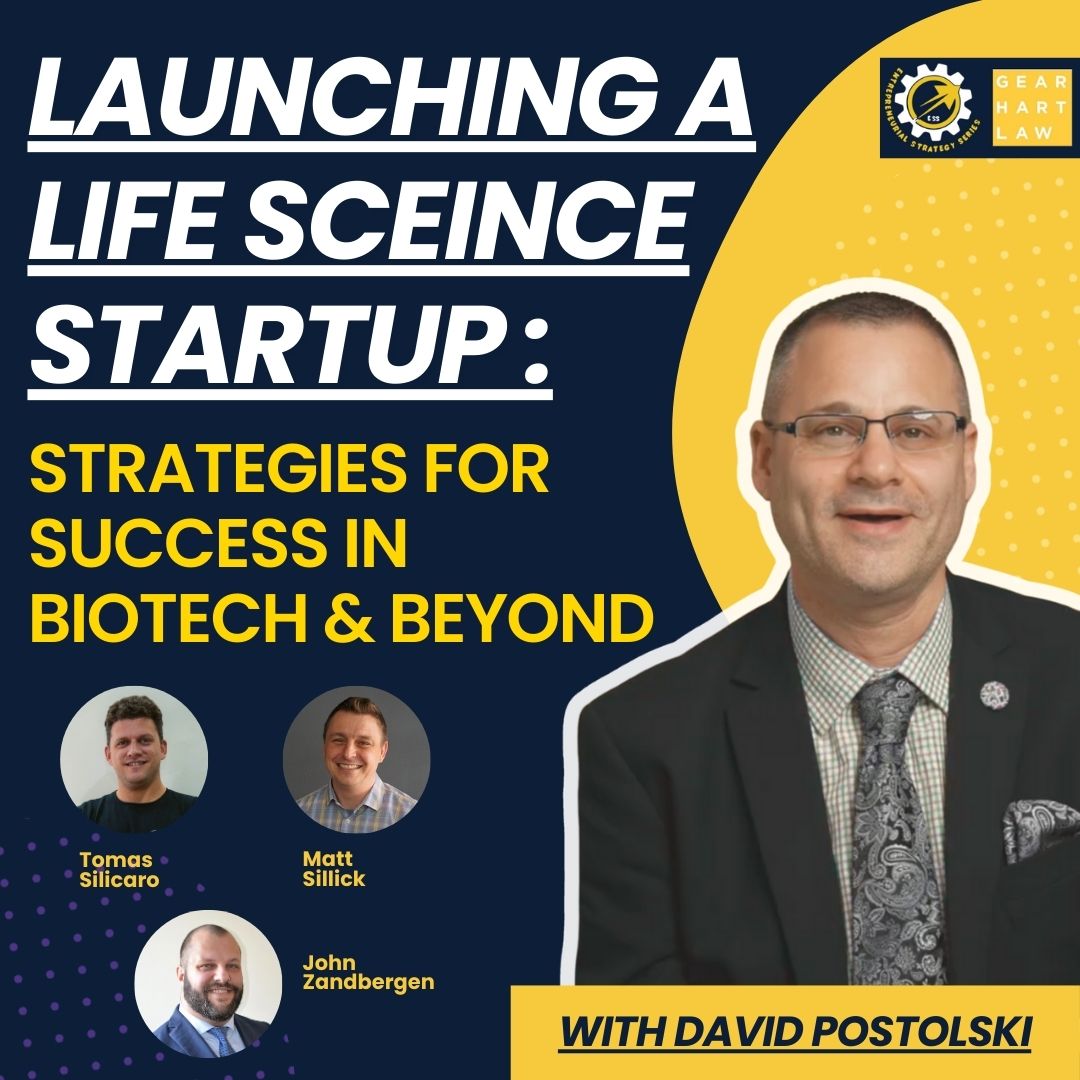
[00:00:00] Speaker A: Okay, everyone. Hello and welcome to the Entrepreneurial Strategy series. My name is David Pistolski. I am an intellectual property and patent attorney with a background in chemistry and computer science.
I've been an IP attorney for over 21 years. Started at really large law firms and really large companies and decided that I wanted to devote my life to startups and entrepreneurs. And so I did that about 10 or 11 years ago, left all that behind and joined the smallest firm I've ever been at, Gerhardt Law, which is in Summit, New Jersey. And the, the rest has been bliss after that. And so I'm all about education and empowerment. I'm a professor at different universities and I think that's really important. I want my future clients and future entrepreneurs and future startups to know exactly what they're getting themselves into. So I pride myself on trying to, you know, make sure that everyone is educated and empowered. And part of that was creating this series and teaching people like you or educating people like you or empowering people like you on all the different things that can come up from concept to exit, as we say. And so because I have a life sciences background and most of the, most of the attorneys at our firm do, we decided that it was time for a life sciences journey, if you will, session.
You know, we've always, we, we talk a lot about patents and trademarks and we'll talk about that too. But the life science journey in particular is a very kind of special one, has unique problems, unique benefits, unique risks and rewards.
And so we invited three founders who you're going to hear from in a second to, to kind of discuss very openly, very informally everything about their journey. You know, successes, failures, stuff like that. Anyway, I'm super excited to introd speakers. They've been, they've been here listening to all of you and so they know kind of where you're coming from and what your journey is and what your interests are. And so we're going to start with someone who's probably closest to home to me right here in New Jersey.
It's Matth, Matthew Silk. And Matt, I'll let you introduce yourself. Please let everybody know who you are, a little bit about yourself, your company, and anything else you want to share. All right, thank you so much, Matt.
[00:02:34] Speaker B: Thank you for the invite, David. It's really great to participate and I think you've done a, an awesome job putting together this, this program.
Yeah, thanks so much. It's really excited to be here.
I'm, I'm Matt Silic. I'm a food material scientist.
I'M in Rocky Hill, New Jersey which is just north of Princeton.
And we have a company called Paragon Pure, which is a, well, it's a food ingredient company. But we are in the life science field.
[00:03:04] Speaker C: So.
[00:03:06] Speaker B: Our, our facility, you know, smells more like a bakery than it, than a fermentation tank. But yeah, we are, we are doing life science.
The company's about five years old now. We started, well six. We started in 2019.
And yeah, we're still a very small company but we are engaged with some big partners. So our, our goal in the next year or so is to put, put our ingredients which is made through a what we call a precision sprouting process. It's a precision sprouted rice flour. We intend to put that into one of the top chocolate companies in the world to help them reduce sugar at the same time bringing alongside the, the, the team that will actually be doing the manufacturing.
[00:03:59] Speaker C: So.
[00:04:01] Speaker B: A company that has a large built in infrastructure for doing biotransformations at scale. So that's yeah.
[00:04:13] Speaker A: Awesome. Okay, great. Matt, we'll come back to Matt. Now we're just asking our speakers to introduce themselves.
So let's go to Tomas. Probably the, not the furthest away, but the furthest way will be John in a second. But Tomas, if you can take a moment to introduce yourself, that would be amazing.
[00:04:38] Speaker D: I think I'm the farthest away today because I'm in Argentina, so.
[00:04:42] Speaker A: Oh, you're in Argentina. I thought you were actually we're in Tulsa, but maybe you can get, you can get into that a little bit.
[00:04:47] Speaker D: Yeah. Okay. Well first of all, thank you David for the invitation.
As I told you more than once, you are the only lawyer that make IP fun and interesting. So for me, that's incredible.
So. Well, my name is Tomas Ilicardo. I'm the CEO and co founder of Biotechnics. We are a biotech startup that we started in Argentina in 2020 first after being incubated here by a biotech company builder called Gridex. Then we did an acceleration program in New York, in Dubai, New York where we met David. And since then we've been working with him.
And we moved the three founders to Tulsa, Oklahoma last year to install our facility, commercial office and lab there.
So it's been a huge move but very interesting. And in our company what we do basically is we developed a new generation of green solvents being fairly natural, biodegradable and cost effective. Capable to replace many of the petrochemical solvents and ingredients in different industries like personal care, cosmetics, food, agro, and many more.
And we are starting to commercialize our product. So very, very interesting and well, more than happy to be here and, and we'll learn from you all in this first half hour and hopefully I can share some of our experience so. So you don't make the same mistakes we did.
[00:06:15] Speaker A: Perfect.
Thank you Tomas, we'll come back to you. And now I thought he was the furthest because he's all the way out in Europe.
John Zandenberg, who are you? What are you working on? Thank you for joining us. Go for it.
[00:06:31] Speaker C: I think I'm definitely prefer this. It has to be right. So I'm gonna talk to you guys today with a couple of Dutch words. So excuse me for that. So my name is John. I will spare you my last name because it's impossible to pronounce anyway. For you guys, I'm from the Netherlands, a company called Autobionics. I'm there, the CEO.
Been doing that now since 2021. Before that I had a consulting company, met a couple of people within the biotechnology field. I was consulting for a company in the bioprinting field that just actually built their own first bioprinter. And some of the investors wanted me to consult for them to see what we can do with it. Conclusion wise was basically they made a nice machine but unfortunately it could not solve the problems that were there. That was bioprinting actually needing to be solved. I met a guy called Dr. Stephen Gray, PhD, huge experience within the cell culture feed with different kinds of bioprinters. He had knowledge about a professor in the University College of London, somebody that actually developed a new technology based on electric field technology.
Better for the cells. Everything worked, no limitations anymore. So basically what we did, we brought them together. We started the company in 2021. We're utilizing his technology, we improved it and now we're making human skin. Skin for research, skin for future therapeutic applications.
We started in 2021, the machine was ready in 2024. This year we started with the skin development and hopefully 20 a product onto the market.
Yeah, very interesting journey so far. Learned a lot, made a lot of mistakes, fixed the mistakes. So that's also important. If you want to make mistakes, you also have to fix them. And yeah, here we are. You know, anything you want to ask, anything you want to know, we're here.
[00:08:16] Speaker A: John, maybe we can. Okay, so we're going to stick on you for a little bit.
I cannot have one of these sessions without talking about intellectual property. I am a patent attorney. I know I'm probably the first Patent attorney to not advocate trust for patents. Like there's other forms of intellectual property, you know, trade secrets and trademarks and copyrights. Can you talk a little bit about intellectual property? Maybe just as, you know, generally speaking, but maybe even specifics, you know, as it relates to your, to your current company or maybe in the past. Anything you can kind of share would be great, I think.
[00:08:55] Speaker C: Yeah. So for us, IP is important.
Especially what we've developed is a new methodology. So this is one. Together with Dave, we actually developed this patent strategy to develop this, to patent this methodology. And that's the basis. So the technology on its own is able to create different kinds of levels of human tissues. We're focusing on skin, but in the future we can do different kinds of organ types as well. Now what's important is that every time you develop something new, you actually have to additionally protect it. So what we can do is actually file a new patent based on the application that we're doing in combination with the methodology that we have designed. So that's actually our future pathway. Now we've been thinking, of course, can we keep it a trade secret? But ultimately anything can be reverse engineered and especially in biotechnology, there's a lot of smart people out there. So we have to patent it.
[00:09:49] Speaker A: Yeah, no, that, that, that, that, that's, I think that's an important concept and I think maybe we can, we can delve into that a little bit. Matt, same question for, for you just in general, I mean you are, you, you are, you, you are a scientist.
How do in, in your current company or maybe in the past or just generally speaking, thoughts on intellectual property?
[00:10:14] Speaker B: Yeah, so before starting a company I spent a kind of, well, 20 years doing food, R and D. So I have some history with patents before then and it was always kind of remarkable the length of time between a patent or a technology and when you actually see an ingredient on a grocery store shelf that is, that is using that. So yeah, sometimes it can be five or 10 years between that, but it's, the patenting step is still critical. So you get an 18 year window and the scale up takes a very long time.
But nonetheless you need the patent stepped in order to, to have, have the, the innovation live on.
Also I think it's the, the patent.
Well, fundamentally what they do is they protect somebody, protect you from allowing somebody else to practice what you're claiming. But it's also a form of communication. So a broad range of people read them and yeah, you, you're able to connect with, well, both investors and, and Corporate collaborators because, because they, they do read the patents. So they have, they have multiple purposes and yeah, essential for, for building a business around.
[00:11:46] Speaker A: Yeah, yeah, that's great insight for sure.
I totally agree. Again, I don't necessarily think it's all about patents, but I think if you are a life sciences company, that's probably what you're going to be living, living and dying by. And that's just, that's just how you, that's just how the cookie crumbles especially. I think that makes being a life science company unique for sure because there might be other sort of kind of technological companies that may not be, you know, throwing everything into their patent basket and doing other things.
[00:12:18] Speaker C: So.
[00:12:19] Speaker A: Yeah, so thanks for those insights, Matt. For sure.
Tomas, same question for you.
How important has intellectual property just in general been and specifically how you kind of use it?
[00:12:37] Speaker D: I think that it has like different ways of using it as the other guys were saying, Matthew and John and as we spoke many times with you, I think that on one thing it's like you need to protect your technology but as well you need to block your competition to the access to similar technology or to the same technology.
So it has like a protection implication but as well a commercial implication on a way where you can block others to do the same thing you are doing. It's not just being the uniqueness or claiming I have the patent and that's it. I think that you limit others to do a lot of things if you are the first one.
And on the other hand in terms of PCs, PCs like a lot to see patents more than they should in my opinion, to be honest.
But they like to see them there. They feel more comfortable if you have an IP strategy and if you have some types of patents with you, even though you don't show everything in the patent, you always try to keep some trade secrets within or at least is what we do. We try to keep part of the trade secrets apart from the patents because you don't want to show everything.
But I think that they are an important part more than anything on an early stage company, biotech or life science company because it gives you more credibility and more like science based robustness that you need to have to be able to raise money. So I think that it's important, it's not the only thing you need but it's a very, very important, very important aspect you need to cover. And if you do it like in a very early, early stage and you try to follow that path, it's easier.
[00:14:28] Speaker A: Yeah, well, Tomas, I'm going to stick on you for a little bit because I said we were going to start this presentation with Anna's question which is where do I begin? Where do you begin?
Like how did it all begin for you? Like was it like oh, let's file for a patent or you know, let's get into a lab first and see kind of what happens. What was it like? Let's get some money.
Where did it all, How'd you say.
[00:14:56] Speaker D: In terms of ip Honestly in general.
[00:14:59] Speaker A: Just in general, in general.
[00:15:01] Speaker D: Okay. I come from 20 years of corporations so I start I was an entrepreneur when I was very young but When I was 20 I got into the corporations and felt honestly very comfortable in there. Learned a lot, but I was doing my MBA and within all these ingredients and solvents that we use in many industries, but particularly I was very focused in food, personal care, pharma and agro.
I felt that I was kind of part of the problem selling those type of products instead of being part of the solution and just complaining of it.
So I said I want to be part of the solution, how can I do? And for me the best way was to meet the critics guys where they kind of match scientific ideas with business people that want to build a biotech startup but don't know exactly what to do. And was part of my problem. Like I know a lot of things but I don't have the technology to build a new biotech startup. And there is where I met my co founders and for me was like the game changer in order to start believing on a biotech startup. When I met them and I saw the technology they've been researching for 15 years, I said well okay, I can sell this. So if I can sell this, it should be a startup. It's like a plug and play to the market even though it takes time because it's been almost five years since we started and we only sold a few liters of the product but we are now in a commercial pathway.
We started that way and in terms of the IP particularly we knew since day one that we needed to patent but we needed to refine the technology that we wanted to use in order to understand what to patent.
And we spoke with several lawyers and you know that before talking with you and when we knew you during the indie bio process, it was an easier way because of how Gerhardt Law does it instead of others.
And it was. And we defined an IP strategy during the program that helped us understand how we wanted to pursue it in three years. Not just the first patent and it's not that it was nothing fancy, but it was like we will be continuously patenting products because we develop at least 20, 25 products per year. So we need to patent and select which of those should be patented and which ones should not.
So that's how we started. And I think that always it's giving the first step, like trusting someone that knows more than you and trying to make that first step.
[00:17:40] Speaker A: Yeah, no, that's great. I mean, I think it's. Yeah. And it's like bigger than that. Right. Because it's like you didn't even know your founders. Right. And they, they were, you were just matched with them and the rest is history. And so there's trust.
[00:17:53] Speaker D: To make it even worse, it was during the pandemics. So in Argentina, we had a complete lockdown. So we signed the Argentinian LLC without knowing each other in person. They sent me a power of attorney to Buenos Aires.
I signed in their name. We received the money. Well, I received it, to be honest. And I met them like eight months later. So we were really willing to do this. And that's why each of us resigned to our past life and to a lot of comforts that we used to have before, but because we are convinced that a better way of doing things is possible and we want to be part of that solution.
[00:18:33] Speaker A: Love it, love it, love it. Risk, risk, risk. Rick. Right. If you're going to be an entrepreneur, a life science entrepreneur, it's all about risk, for sure.
Matt, same question. I know you have a co. Founder, but, but, but, but to real. But, but the question again comes from Anna, who is a, who is a. Who's at CUNY now. And like she asked like, how'd you start? What did you do?
[00:18:57] Speaker B: Right, yeah, that, that the point that Tomas hit on wanting to be part of a solution rather than being part of the problem really resonates with me as well. So it's.
Yeah, I was in the food industry doing food, R D, whatever, wherever you are, you start to kind of see problems and you, you try to brainstorm around solutions. The.
I think before starting, you really need to know your space. So you, it doesn't make sense to patent anything unless you've read a lot of patents that are adjacent to it. And that's also a great way to kind of start coming up with ideas as well. So behind every patent is somebody that believed in something and there's a lot of good ideas and patents that never, that never, never. You don't encounter them outside of the patent itself. So not every patent turns into a business, but nonetheless they have good pieces of, good pieces of information in them that someone skilled in the art needs to be aware of. So yeah, if you, if you want to build a technology business involving patents, you need to know your space and you need to.
[00:20:24] Speaker C: Yeah.
[00:20:25] Speaker B: Know, know the prior art very, very well.
For me, I think similar to Tomas, again, the, one of the things that nudges you and pushes you over the edge can be these accelerators. So SOS V helped both me and my co founder to say, you know, hey, yes, if, if these guys believe in it, I believe in it. Let's, let's go for it. So there are for better or worse, they kind of give you a kick in the pants to, to get moving on a problem that you want to solve.
[00:21:01] Speaker A: I can't agree. I want to come back to accelerators but I want to ask to thank you that I think, thanks for bringing that up because I think it's an important part to the life, to any kind of entrepreneurial journey is having those, those early kind of believers in your ideas. So we're going to talk, we're going to get back to accelerators in a second by. Did you meet your co founder, Chris? I think I know the story but I can't remember.
[00:21:26] Speaker B: He first hired me at a flavor company I know 30 years ago, so I've worked with them in the past and then he went to another company. I went somewhere else but just kind of always, always was somebody that I, I liked working with.
So there, there's, I don't know, there are kind of studies on like what makes a good founder, co founder combination and whenever we're in those analysis. So we'll do like a personality assessment. We're, we're almost the same which is, is, is can be a problem because that's, that's not the model you're supposed to hit.
But yeah, we have a long history and a lot of trust and so that helps for the idea development process. So there's no, there's much less risk and we kind of think along the same lines and yeah, can, can help develop ideas together.
[00:22:35] Speaker A: I love that because if it's not like Tomas taking a risk with somebody who doesn't know, it's about the relationships you've made just throughout life and, and, and, and how you're supposed to capitalize on them at certain times. So.
And that has a little bit of risk too for sure, but maybe less than maybe not knowing your founder from the very beginning. You know.
Okay, great John, where did it all start?
Where did orobionics all start? How, how did you start?
To answer Anna's question, where do you start? Where'd you start?
[00:23:07] Speaker C: Yeah, well, just actually it happened, you know, I actually met my co founder Stephen during the time I was consulting for this bioprinting company. And basically what I do when I look at a product and see what, what, how, how to put it into the market, first talk to every kind of industrial stakeholder to see what is the expectation, does this product actually fit the market.
And Stephen was one of the guys that would actually had a lot of experience in this field. So naturally we started talking. He's an Irish guy by the way. So we met a lot of times in the Irish pub, had a couple of drinks with each other, chatting with each other all the time. He said, what is missing here? You know, it's so much potential, so much promises, but why has it been failing with the technology? He says, well, it's just a technology and he knew actually a guy that had the right technology, but the guy that actually invented the technology.
It's an odd one, it's a professor, he doesn't like the industry, he's very skeptical of industry. He's been approached by several industries to say, you know what, we would like to take your technology out of the hospital.
He doesn't like them because what he wants, he wants the technology to be used for, for an application that actually has an impact, right? So for him it was not about developing a system that could be solved. For him it was developing a system that could be used for application that can make an impact. Now one of the biggest impact that he found is that we need to get rid of these animal trials because they're completely redundant.
And for him that was a big thing. So actually we listen to him and that's how you form your team. So our founding team is actually five persons. It's two persons on the business industry side, but three academic professors that everybody brings something to the table. It could be a little bit of ip, could a little bit of know how, but combined it actually allows us to do what we want to do. And I think that is very important. The team that you form all have to face the same directions, all have to be motivated, all have to strongly believe we can do this. And we still strongly believe we can do it. And we actually have shown that we can do it. The system is great. We've already sold a couple of them with two academics that actually want to collaborate with us. The skin is Looking great. So yeah, definitely, everything going in the right direction.
[00:25:12] Speaker A: I think you bring up a, a really good point, which is the belief, right? Passion for it, right? Like you need to, you need to know, you, you, you. They cannot waver on that. I mean it's going to be so effing hard out there and there's going to be so much rejection. But you need to believe, you know, you need to. Belief can, can work wonders for sure.
[00:25:36] Speaker C: But you start your words on paper, right? And, and maybe good words on paper, right? Lovely words on paper, but only words on paper. You have no money. You have an idea. You maybe have some publications in the back, but you have nothing tangible that people can see. Then you start talking to people and talking to people is your main job. You know, keep talking to people until you find those people that say, you know what we believe in, what you're going to do, we're going to fund you. And that's where it all starts.
[00:26:03] Speaker A: Let's talk about it.
[00:26:04] Speaker D: Money, money, money, money, money, money.
[00:26:06] Speaker A: This is expensive, right? I mean like a life sciences company is expensive. It's like labs, it's like, sure.
So can you talk a little bit about like so money.
Where do you go? What'd you start? Was it your own? Did you bootstrap? Did you, did everybody put a little in? Did you just immediately find investors? By the way, Matt and Thomas, you'll get the same question. What did you do? Money, cash flow.
[00:26:38] Speaker C: You talk, you talk, you talk to everybody. Starts finding the believers that understand first of all what you're doing, right, that that's a key issue.
It's not something simple to understand, you first have to dumb it down. And unfortunately, right, if you're talking to investors, they not always are equipped with the know how that you have have. So you have to put it into a terms that they understand.
Finding other people. Because there's two types of funding. Money makes the world go round. In the beginning you put your own money in, right? You fund yourself everything that you can. But ultimately, yeah, that's not good enough for a life science company. You need to have serious money coming in. So diluted funding, non diluted funding. I'm a big fan of non diluted funding in the beginning because that really proves that you can actually do it. Those are people that actually will to give you money for free to actually start doing something. And that's what we got in the beginning. We were part of a big growth fund project first only in name. We were just one week in before the entire growth Fund project and those was signed off. We were actually introduced to them. They loved our technology to see the potential. They only wrote our name company Aura Bionics on the list to be part of that consortium. That's how we started. We got no money. Then things happen. One company dropped out. So there was a fund available. We jumped on it. Right. Doing all the work that we are trying to do. So after that we just basically got the funds in started hire the number key personnel is an engineer. I am not an engineer. Steven has some biomedical engineering background but you need to fill in the gaps. That's what we did. We hired an engineer. He turned the idea, the research setup into a machine and then you have something tangible and then you can go forward. We got believe from the regional development agency which is does like a government venture capital group.
They came on board. We got some more grants in. So we pretty much self funded at the moment. Yeah we do look like we now at the seed stage. So we are fundraising again but that's just to grow faster. That's basically also what I think in life science what is needed you can do it organically, you need to have a product that you can sell.
But in order to do it in the right way you need a big bucket of money. That's actually what you need.
[00:28:58] Speaker A: Yeah, no, I, I, I, I, I think everybody on the call appreciates your honesty and transparency. I think it's really important and it, and, and it might be a similar story for Matt, for Matt and Tomas.
Matt, what, what, what money?
Was it yours? Was it others? Was it you know, opp. You know, other people's money as we say. So can you, can you shed some light on that from the beginning how it all kind of worked for you?
[00:29:30] Speaker B: Yeah. So would be nice if, if it was other people's money immediately and right from the start. But that that wasn't the case for us either. Right. So there was some, some of my money, some of yeah some of our own money to get started. Then there was similar to John. We we won a couple of small grants and that, that helped a lot. So that helped to, to keep the lights on. And it helped with you know in the background you're still going out to customers and still trying to develop projects on the side. But then you have a grant project that you're working on. So we had a USDA grant.
And yeah, that was, that was the first time that I could start taking salary. So that's another part of it too because if you don't have any money Then you don't have a salary either.
So once, once we had some non dilutive funding we were able to, to take salary and then we also got money. Well the even still now most of our actual revenue comes from corporate partnerships so pay to play type of projects. So you, you write a pocket and you convince somebody at a larger company that hey, not only do I want to look at this ingredient but this is pretty serious. We should, we should pay to put a nine month project together and work directly with these guys.
So that, yeah, that's a great way because it also helps you to refine your project, your product. So yeah, it's a critical piece of the funding is finding customers that are interested but not only just interested but willing to help you develop.
[00:31:38] Speaker A: And Matt, Zach has a question that I think is important because you mentioned grants and grants and so did John. Again grants are like non dilutable. It's like the best type of, you know, kind of funding you can get.
What was that process like? He asked did you hire, did you hire a firm? Maybe didn't have money to hire a firm at that stage but did you do it on your own? Did you hire a grant writer? There's all sorts of resources out there. Did you do any of that? You did it on your or you did on your own?
[00:32:11] Speaker B: We a little mostly on our own but we did meet, we met a consultant that made the process a bit easier. So he didn't write the grant for us but he helped us to understand the mechanics of applying for US grants and that was worthwhile. So there are, well there are a lot of consultants out there that are worth working with. So yeah, that was a big help.
[00:32:48] Speaker A: Awesome. Yeah. And John, thank you for answering because John also applied for grants and so his, his answer is there as well.
Tomas, money, money, money, money.
How did it all go?
[00:33:03] Speaker D: Something we lack of in Latam. So it's, it's very different.
I don't know what like all the people that it's connected today or who is going to see this video recording is from but I think that it's very different where you start your company and how you want to start it and get that funding.
In Latam honestly grants are very small, many of them are dilutive so it's kind of tricky there.
And even if you are a LATAM founder that moved to the U.S. if you are not a U.S. citizen or your company is not a U.S. owned company and at least 51% you cannot apply for federal grants, almost any of them. There are some but Very few and even now they are fewer.
So it's kind of difficult for us to think about grants. Even in the EU it's the same thing. You need to have a kind of a corporation or an LLC established in the EU to be able to apply for grants. Many times those grants have to be spent at least 70, 80% of that money in the EU. It's not that you can apply them from the US and use all the money in the US so you need to be to be aware of all those little notes when you want to do that. However, if you can take a grant, take it, embrace it, use it as much as you can.
For us it was different. We received a little bit of money, 200k to start the company from the company builder but we had to give away 25% of the company for that. So it was a very very stressful moment because we knew that we wanted and we wanted them to be part of the company because they are like the fourth founder of the company. Honestly they are very in with us, they give us a lot of things and they help us a lot with, with a lot of things.
So for us it was kind of difficult but as well kind of a no brainer because we knew that they were going to help us. We started with that and then we overlapped jobs for a while.
I was the general manager of another company and I overlapped jobs for more than one year working 20 hours a day, Saturdays and Sundays too just to make it happen and not taking a salary from the company and from the startup. And I started taking a salary that it was a quarter that what I used to earn in the other company and putting my savings in just to live to make this happen. And I started collecting a good salary when I moved to the US So it was like one year and a half ago.
So yeah there is a lot of sacrifice, yes there is a lot of or things you need to to be able to do in order to make this happen.
But we all believe in the reward. We are not here for the salary, we are for the equity and we are for the long term vision.
So if you are able to do so for me it's like do it, you don't have to think about it. But for us, the, the bc, the bcd, I don't know pathway, it was not easy. I had 107 PCs interviews before we raise our seat round.
Many of them I met them through in the bio but they were 107 and only three of them said yes.
So the rate it's very, very low. But we say there is a saying in Argentina that you have to be a Carradura, like a stone face.
You don't have to be offended if it's a no. It's. Well, it's not. Now let's recap in 3, 6 months and keep searching, keep searching, keep searching because when a couple of PCs say yes, another one unleash and you get that momentum and then others come and others will want to get participate but you need to say no to those and, and not be greedy so you can have them in a following round and that's better because you will get a better valuation and so on. So it was not easy, but it was fun to be honest.
[00:37:36] Speaker A: Yeah. Wow. 107 yeah, you definitely got to take rejection, you know, not personally for sure.
You talked about Indie Bio, which is an accelerator in the United States.
Can you talk a little bit about whether you thought that experience was valuable for you, for your company as a life sciences company? I mean it almost.
It's really hard to not be associated with something these days, right? An accelerator university, an incubator. How important was it for your company today or in the past or, you know, currently?
[00:38:22] Speaker D: Look, we been part of 8, 10 different accelerator programs at least and we are still part of, I told you, we were part of Endless Frontier Labs. We are now part of that program at the nyu.
So I think that the accelerators are a good platform for you to network and to have connections. All of those platforms, accelerators have connections in different countries or different regions or different industries and with different VCs that can help you grow your network and get closer to your objective.
Particularly in the bio, for me it's like top three in the world in biotech, particularly for me is the best is the number one. And for us it was like an ISO certification of quality of biotech company that made us a little bit easier the path to a seed round and to connections with customers and networking with other startups and so on. So for me, Dubai, it's one of the best, if not the best acceleration program that we've been in. But we've been part of Plug and Play Japan, Plug and Play US Mass Challenge in Switzerland, in Argentina, in Brazil, in Chile and now in the US again in Europe, some others.
So in Spain, in France.
So I think that all the acceleration programs are good and give you some added value if you take the time to use them as you need to and you are very clear of the objectives that you have at that moment. And that you need to achieve. Because if I do in the bio today, it will be totally different than what happened in 2022. The companies told, I think we had like six companies in these three years, so. And it's the same company, but it's not the same.
So you need to be very clear of what you want to achieve during that acceleration program. As a starting point, obviously in the middle you will change because you need to change and you need to be open to change.
So for me, acceleration programs are a must in any startup.
[00:40:33] Speaker A: Yeah, I totally agree, Matt. I actually met Matt at another SOSV accelerator that actually doesn't exist anymore. Was, but was around for eight or nine years and launched 16 cohorts. It was called Food X. How important was that kind of journey to you and kind of are. Are you affiliated with any, you know, still today that kind of help you accelerate?
[00:41:03] Speaker B: Well, yeah, for sure. We're, we're, yeah, we started at Food X so that was the, the first accelerator and at that time they took a, a small piece of equity. So we're, we're still very much associated with them. They're on our board and when we raised a seed round, they came in then again too. So yeah, Food X was the, in some ways it was kind of. Well, it was, it turned into indie bio essentially. So it, there, there are a lot of food companies that went through indie bio, but prior to that was, was Food X before biotech kind of showed its, showed its, its rise.
I think they're really very valuable and they're great for, for helping you to kind of create a stage for your, for your, your company and your, your project. So in the beginning you have this.
Well, you have a lot of potential and you're kind of simultaneously have something that's both very, very promising, but also nothing at the same time, depending on one's perspective. And so the positioning of, of an innovation is super important in, for making it happen. So and SOS view is awesome at that. We've done, let's see Mass Challenge, Plug and Play as well. And they're more, more focused on corporate collaborations, which is another very, very valuable, very valuable thing.
They're, they're, I don't know, you can, you can get a lit little bit pitched out. That's kind of something that happens is like you, you want to actually make a company make an ingredient and not just spend all your time pitching the company all the time. So it's, you can get overwhelmed by it, but it is, it is part of the, it's Part of the process?
[00:43:18] Speaker A: Yeah, for sure. I mean, you got to be comfortable with that.
[00:43:21] Speaker C: Right?
[00:43:21] Speaker A: At the end of the day, you got to be comfortable talking about your successes and failures and asking for money. And that is hard, for sure. It doesn't come naturally, especially to scientists. Right. It's not a thing. So you have to really practice at it, for sure. And I think Food X and other accelerators just, you know, do that to you. They, you know, they mold you into that. And so it's important to kind of go through those processes as much.
[00:43:47] Speaker D: David, I would like to add something to what Matt is saying, like.
[00:43:50] Speaker A: Yeah, please.
[00:43:52] Speaker D: It's. When you start doing these acceleration programs, it's like it gets nice and you know people and you travel, but that's not the objective. And many times I think you see a lot of startups that are traveling all around the world every year and you say, well, when are they working in their product? Because they are traveling. What are they doing? And you don't need to, you don't have to fall in love in being the winner of a prize and blah, blah, blah if you don't progress with your tech or with the customers approach or the outreach to your customers. Because if not, at the end of the day you will be a startup winning prices and that's it. But you will never convert into a commercial company.
And I think that that's the key. Like use the accelerations in your favor. Don't be just part of the acceleration journey. And that's it.
I think what just what Matt just said, it, it's key, like don't fall in love in pitching and nothing else. You need to be effective.
[00:44:53] Speaker A: Yeah. Matt, did you want to comment on any of that?
[00:44:57] Speaker B: Just so they, they, they help you pitch.
I've, I've always struggled with pitching. It's not, it's not my favorite thing to do.
So it's, it's. There is no risk of me ever turning into a serial pitch performer.
[00:45:17] Speaker C: So.
[00:45:19] Speaker B: Yeah, but, but it can feel like that sometimes and that's that it. You couple that with rejection and it, it's harsh.
Especially when the, well, you, in almost every time you get rejected, you, you don't agree with the rationale for why you're getting ejected. So you, you think people are wrong, but you can't. That doesn't matter what you think. You're still, you're still out there being, getting rejected.
[00:45:52] Speaker A: That's true. John, have you been through any sort of accelerators or anything? I'm not sure I even know.
[00:45:59] Speaker C: No Actually not. We have not been part from any accelerator, not incubators. We did select some of these organizations. One of the organizations for example in Europe is hello Tomorrow dtech organization that focus on companies and creating a network. We've been selected as a deep tech finding but like, like Thomas says as well that was not the goal you know to be selected for us. Those events are network events. You can meet investors, you can meet all the potential partners, people that you can form a consortium with. Now that is the, the goal not to win prizes. This prizes are nothing. They're peanuts that cost you more money than the price money that you actually get from these.
So for us now we've been invited like Saudi Arabia wanted to have us as a, as a startup company but then I had to go to Saudi Arabia every month. Said that's not worth it. Right. That cost me more time than a little bit of money I'm getting. And then I also have to incorporate a company in Saudi Arabia. We don't have the time for it. It's not part of our plan. So let's just focus on what we're doing and don't get wild of getting free money because free money doesn't exist.
[00:47:01] Speaker A: Yes, well said on that note because I think it's important for, for people. By the way if anybody. There are questions I saw coming in and thank you for John and others for, for answering them especially as they're coming in. But if you want to ask a question just maybe raise your hand. But we'll get to that in a second.
John, mistakes made. I mean that is like you know that's a common question that I ask and we, and actually none of you have really even mentioned the word mistake yet. So I'm very curious how this is going to go. Go tell me. Mistakes made.
[00:47:39] Speaker C: Every day decisions are made. You know what you make decision based on information that you have at that moment. If you go back and, and and we often play this game where we should have done this, we could have done this. I hate should have would have cut of managers. Right. Because those are the ones that never going to make a decision. Sometimes you have to make a decision, it's the wrong one. But at least you make a decision. We've had mistakes on team right. Getting somebody on board which we thought would be a perfect business developer. She was very scientific, extremely scientific. Too scientific. She could speak hours to professors, not sell a thing. Right. Wrong choice. We had some assumption on we're lacking like electrical engineering, embedded engineering for software. So we thought you Know What? Maximum budget, 35K.
We said, you know what, we can do that through an external party. Now that 35k became 125k, we could have hired four people for that. So, know, you make those kind of mistakes and ultimately would have made the same decision again with the information I had that time. 100. Because it was the best decision. But those kind of things you go through, you have to acknowledge it was a mistake. You have to fix it as soon as possible. Because if you keep lingering on. Yeah. You're only going to waste more money and, and trust me, you're going to waste a lot of money. You're not going to do everything perfect. So even if you think you need 500k, get a million. Because you are to going to make the mistake that's going to cost you the extra half a million.
[00:49:02] Speaker A: Love that. That's great. I mean, thank you for sharing that. That's really important.
Mistakes made. Matt, Anything that you can generally speak to or specifically speak to.
[00:49:16] Speaker B: Well, I, I think, I think, I think one of the mistake we've made is that when we take on a pivot, it's hard to go all the way with the pivot. So you.
We end up, rather than pivoting, branching, which is.
Well, it's kind of natural because you still kind of believe in the first thing you're working on. You just think maybe it hasn't met the right, the right customer. So you're reluctant to kind of kill things. But yeah, you can. You can only work on so much at a time. So I think, I think when you pivot, you should pivot hard.
[00:49:58] Speaker A: Yeah. Go all in or not, Right?
[00:50:00] Speaker C: Yeah, yeah, yeah.
[00:50:02] Speaker A: Tomas, mistakes made.
[00:50:06] Speaker D: Do you have time?
I think that we make mistakes every day, but because we are trying things and it's part of the process, I'm not the ones that really celebrate failure, but I don't condemn it neither. So I think that it's part of the process, making mistakes and learning from them.
I think that some mistakes were more than anything in terms of focus.
When you start, you say, well, I will do all this, and then you understand that maybe there are three different industries that speak three different languages that have different approaches, that the champion of those industries are totally different and you need to outreach them or to get to them in different ways and you don't have enough money or time or resources. In our case, it happened. So we need to kind of pivot within industries, not in terms of the business model or the product, but on how we needed to approach and how much time we should put in each industry.
And I agree with Matt. Fortunately, the very first time we did it, we did it hard and it was good. The second time we didn't do it as hard as the first one and it took us more time than what it should do.
So I think that you always need to be open to mistakes, but more than anything need to be open to solve them as well and not to just leave them. Oh no, this is a mistake. Erase it. Well, let's take the good part of this mistake and convert it in something else or at least try to make something better or add some value from it.
But it's a daily thing. Obviously you don't want to, but it's part of it.
[00:52:04] Speaker A: Yeah, that's right. I mean it's tough, it's tough to be, it's tough to be a founder for sure. As you all heard it it there, there's a lot of qualities that you all that, that, that you all need and, and probably don't possess them on your own. And that's why you need a team.
So where are you now in the company, Tomas? And it's, and, and you know, there's people going to be listening to this that could possibly help in some way. Where are you now? What do you need?
[00:52:38] Speaker D: Money.
[00:52:38] Speaker A: Always it's all about money, right? I always say that it's all about money. Forever raising money.
[00:52:45] Speaker D: I was last Friday I was in, in the NYU program and they were saying, okay, are you racing? I'm always racing, but I'm not racing. So. But if you want your best, I'm open. So that's true.
But no, honestly, we are in a very good, good spot of the company in terms of science. We, we made a lot of very good breakthroughs this year. We have seven products that are really solid that we are starting to commercialize in the next couple of quarters and we are very happy with that. We are starting to close the first commercial deals, long term deals that are really interesting for us. So what we need is that more than anything, we're very focused in personal care and cosmetics. We developed alternatives of diprocylene glycol, exylene glycol, eutectic aluronic acid, that it's much better and much cheaper than the actual ones. Some other alternatives for that in polymers. We are doing a lot of breakthroughs that are very interesting.
So what we are needing now is to close more deals and to have.
We are looking for investors but like key investors that can help us build that next Step of the company in terms of outreach or real reach to the key customers or that can really add value to the team that we have today. And we lack some things off obviously that can give us that extra mile that we need.
So there is where we are. We have our facility in Tulsa with 5,500 metric tons capacity today and we can enlarge it very easily.
So we are happy with that and we are building a team in Tulsa too. So if anyone is interested go to our LinkedIn page. There are four posts open today, four job positions.
So yeah, that's where we are today.
[00:54:36] Speaker A: Amazing. Thank you, thank you for sharing. John, where are you today?
[00:54:42] Speaker C: Today we are in the so called Valley of Death.
[00:54:45] Speaker D: Right.
[00:54:46] Speaker C: Right between pre seed and seeds surviving very well to be honest.
We got a system ready. We have the first system soldier hold. So that's a very good acknowledgment of people being interested, willing to pay which is also good. Right. Good margins on it. So we can survive. But really if you want to progress faster then you need to have the seed round in now.
Looking for investors is a mission. You've heard it before 107 meetings. Well, I think we've surpassed the 200 now. We've written to more than 500. You really to find the right investor that understands what you're doing, understands where you're going and actually has the network and the capacity itself because it's not only about the money of course. Right. So yeah, doing very well with a good team, right. We, we have fun with each other is also very important because you put in a lot of hours. Even the people that are actually employed officially have to work from 9 to 5. Have they come in early in the morning, they leave it late. We work in the weekend just to get things done because you know what it's nice to do, right? You shouldn't do this if you don't like it. You only do this if you really like it and completely crazy because you need to be crazy in order to do this. So yeah, we have fun. That's, that's the most important part. And yeah, as soon as we get the investor we will have more fun.
[00:56:00] Speaker A: Yes John, I love that for sure.
Matt, where. But by the way, before I go to Matt, if you want to ask a question, now's the time. You can raise your hand. We'll call on you, you can chat your question as well. But Matt, where are you today?
[00:56:18] Speaker B: I'm right next to John and Tomas in the Valley of Death. So we're, we, we did our seed round a couple of years ago and we've, we're, as I was saying before, we're still, we're still in this position where something has really great potential. But getting actual bonafide customers to put ingredients into their food when there's no, no other company offering the same ingredient is, is, is tricky.
But yeah, we've got great traction in terms of regulatory positioning of our ingredient in terms of manufacturing and collaborations with, with, with, with companies that hope to help us to scale and put it into, into some of the largest, largest food manufacturers hands. So there's lots of reasons to believe we're probably looking at a seed extension in the next six months.
Yeah, so that's, that's going to be before series A is, is putting together a seed extension, hopefully involving people that we've worked with, you know, day in and day out over the last three years and you know, making, capitalizing on the progress that we have in these projects.
[00:57:42] Speaker A: Love it.
I want to ask all of you kind of a final question. If there are no questions, I want to ask all of you, let me add all of you here again, if you have a question, just raise your hand on zoom or take yourself off mute because I can't see everybody. So just FYI, the life science journey, right? If looking back on it, like looking on it, looking back on it and on it, what is.
Give me a few words on this, you know, journey because, because it is a unique type of journey. Being a life sciences founder, I work with a lot of other founders, you know, tech and, and mechanics and electrics and you know, creating a widget and stuff like that. It's different. It's different for sure. It has its unique aspects. So just the question is we'll start with, with Tomas. Looking back on this life sciences journey, what, what comes to mind? What sums it up?
[00:58:48] Speaker D: I would do it again, that's for sure.
[00:58:51] Speaker C: Love it.
[00:58:53] Speaker D: And what I would change is more my own expectations in terms of timing.
[00:59:01] Speaker C: And.
[00:59:04] Speaker D: Take that to my investment board as well in order to align a little bit the expectations on timing. Because I think that the big challenge that the three of us have here is that we are introducing technology that it's totally new.
Doing that for any middle size to big size company. It's very risky for many things. First regulatory if you want then the real effect that this tech will have in their product. But then you have supply chain integration, you have the risk of not delivering as you expected to. And you're a startup, you are trying new things every Day you don't have the assurance of 20 years or 30 years as they have and the money that they have to solve, solve it in two days.
So I understand them even though I don't agree with the way so many times because many times you have a lot of bureaucracy that it's necessary in corporations, but that take a lot of time.
So one thing that I would really change is it's kind of the way of how I expected things to happen in a very shorter time than what it really does.
And the other thing is trying to be context is context, right? Like this year was very different in the US than last year.
I'm very used to this type of crisis because I'm from Argentina, but it was very different in the US and as well when we started the company in 2021, sustainability was in the top of mind of everyone and everybody was prepared to pay a premium. Today is a must and you need to be cheaper.
So things change like faster every year. So you need to be open to adapt faster as well. So the only thing that I would change is like making some calls faster than what we did and have a better expectation on timing.
If we could change those two things, maybe the results should, would have been better or faster.
[01:01:10] Speaker A: Love that. Thank you for sharing that insight. That's important.
Matt, what do you think? Looking back on the life science journey, what comes to mind?
[01:01:19] Speaker B: It's.
I, I love the, I love the, the kind of, the nimbleness with which we can, we can work. So there's, there's a lot of great things about building out your own labs, hiring the people you like, hiring people that are good.
And yeah, it's, there's, we're able to kind of define a problem and, and build around it quickly and that's, that's really exciting. I don't know, it can't, can't happen everywhere. But it's, it's a super fun part of, of what we're working on.
So it's, I'm really enjoying myself. It's great. I, I think we're onto something that can have a big positive impact on, on nutrition and health. And I, I love, I love working on a big challenge. So it's, it's.
Yeah, that's, that's comes with the territory. I love it.
[01:02:19] Speaker A: I think all three of you, my, I think I've clocked all of you that said the word fun, so that's great. I think that's really, I think that's the, that's, that's the key lesson Here, just have freaking fun. John, what do you think? Looking back on the life science journey, what comes to mind?
[01:02:33] Speaker C: I would definitely do it over again. Look, I'm from housing, I'm a lab technician, we work three months in a. Then ran away screaming because I thought if I have to do this for the rest of my life, please shoot me.
Have always been in business, always been a new project, those kind of things. I thrive on success. So you know what the fun is of the startup? There's little success that you get your first pre seed fund, your first sales. Those kind of things are such a high and that makes it all worth it like if you want to change something.
[01:03:00] Speaker B: Yeah.
[01:03:01] Speaker C: Lower the expectations even lower I think because you know you're very high up, you very motivated, you're very optimistic and you live on Hopium so it's a great thing.
But yeah, you don't have a glass ball, you can't look ahead what's going to happen to you? And always something will happen. So if you make a plan, throw the plan in a dust bin and just see how it goes because things will happen, things will pop up. You just have to figure out a way of organizing and keep everybody motivated. That's the most important part.
[01:03:31] Speaker A: Yeah, totally, totally. I totally agree.
There is a question that I think I want your feedback on because there are, there were if you heard some of the introductions, there's some people in school, there's some, you know, people that are studying to be scientists, people that are probably looking for opportunities. So I, so Sanji decides what qualities or project examples do you look for in early career hires that show they can contribute meaningfully in a biotech startup setting. And that's important right? Building your team. You've all talked about it a little bit. Anybody want to or maybe all of you want to comment on this?
[01:04:06] Speaker C: John, what do you think hired young people? I, I love to work with young people. Right. They have a different kinds of mindset knowledge know how we do look at I, I think motivation is the most important part.
If I look at our latest two hires they all come straight out of the PhD of other postdocs haven't worked any corporate life.
Yeah, I'm, I'm a different kind of manager. I, I don't believe from nine to five, if you want to walk in ten and you want to walk out at seven o' clock in the evening that's fine. You know what? It's all about getting stuff done.
Yeah, I do look at people. Look, you're a company, you're very small so you're growing. These people that are the early highest tend to also grow with the company in a more, better role, higher role. This is something I do look at. Is there something in there that have the potential to become a future manager? For example, our engineer is now the cto.
We sent him on a CTO course because he had no management experience. So you definitely have to form them and he's now, he's now a key person in our company. So we now have a tissue engineer. Tissue engineer. We tried to look at her and see can we find a future CSO in there because that's very important. Right. You need to at some point generate your entire management people and I like to give those people the chance that come on board early. But don't expect high salaries because that's not allowed in startups.
So you have to grow with the company.
[01:05:31] Speaker A: I love it. I love it. Thank you for that.
Matt. What do you think Tomas? Then you.
[01:05:37] Speaker B: Yeah, we've been, we've been fortunate with, with hiring and a skill set that I appreciate is, is being, being active and finding ways to help the company. So don't just rely on me to tell you what to do do day and day out and you see the problems, you see what's going on, find some way to help me. And yeah, that's, we have, we have people that are able to do that. So we have a, you know, a food scientist that's well better at logistics than I am so she can handle when materials coming in and out of the warehouse. And there's a lot that you can do that if you went to a big company you wouldn't be able to do that because they have six people whose job that is. So yeah, you can find things to do and you can just help keep us swimming.
Yeah, it's really important.
[01:06:37] Speaker A: Love it.
[01:06:38] Speaker D: Tomas, I think that what is key is that you are startup friendly to say that because you have a lot of people that want to have a job but not necessarily want the risk of startup and that's okay, it's not an issue but it's kind of a condition of what a startup needs. I think that John and Matt said it very clearly.
If you want to come 9 to 5, it's okay. If you want to come 10 to 5am it's okay if you get the objectives but as well, if you get to work with the team, you are a team member.
If you are going to be alone all the time, you are a contractor more than an employee. So that's not the idea.
In a startup you need team members that are willing to do more than what their role says in a paper without complaining and understanding that they are helping to grow the company. And if the company grows, they will grow.
And that's the key for us founders. The best thing that could happen is to find those type of people that could be the next managers where we can rely on and delegate and even give them stock options or whatever. For us that's the best thing that can happen always.
But many people don't understand it that way. So I think that the key is that if you want to work in a startup, it's all in.
And I think that as founders will give back if we receive it.
At least it's what I try to do.
And that's the key, like having that kind of startup gene, not, not necessarily founder gene, but startup gene.
[01:08:27] Speaker A: I agree. It's definitely a special type of person for sure to be a founder. So you gotta, you gotta be all in.
In the interest of time. There was one question but we, we, we can't get to it now.
I, I personally want to thank Matt, Tomas and John for sharing and being transparent and, and, and, and, and, and just for sharing their knowledge and, and advice and everything like that.
I, they are, they are out there on LinkedIn so get in touch if, if you, if you, if, if you wanna, if you wanna ask them something specific.
But yeah, guys, I thank you. I wish you I continued success in everything you're doing. I hope you, you know, emerge from this valley of death as you said for sure. But there'll probably be another one right around the corner and so I want to wish you all a great holiday season. Happy New Year. We will be back the last Thursday of January and actually we're continuing on the health sciences, life sciences stuff. Our next ess is all about artificial intelligence and healthcare and so we'll talk a lot about that as well.
But again, Matt, Tomas, John, thank you so much. Thank you for everybody for joining. Happy New Year. See you soon and take care all. Thanks so much guys.
Thank you David.
[01:09:53] Speaker B: Thank you.
[01:09:54] Speaker A: Bye guys. Bye bye.